Prism Embraces Quality Management Standards
Stephen Kooiman, Mechanical Team Leader at Prism Engineering, shares his thoughts on how company-wide quality management helps ensure quality is consistently applied across all Prism projects in the 2020 March/April issue of the INNOVATION magazine produced by Engineers and Geoscientists of British Columbia.
Excerpt:
FIRMS EMBRACE QUALITY MANAGEMENT STANDARDS
Alison MacLeod, P.Eng., of MacLeod Nine Consultants, Ltd.—a structural engineering consulting firm in the heart of picturesque Rossland, BC—says the quality management systems that her firm committed to through Engineers and Geoscientists BC’s Organization Quality Management (OQM) program is a way for her to raise the quality bar and help ensure she’s always delivering the best quality engineering for her clients.
“Engineering is all about planning, diligence, and documentation. [Quality standards] improves efficiency, and it’s good for projects. But it’s also good for my own confidence as an owner of a small company, that my firm meets or exceeds professional obligations,” she said.
The OQM Program is a voluntary certification program created by Engineers and Geoscientists BC that enables companies to demonstrate that they meet the quality management standards expected for professional engineers and geoscientists. Engineers and Geoscientists BC recently certified its 400th firm. To MacLeod, certification is assurance that she’s following top quality management practices, “I just I want to deliver the best quality product to my clients,” she says.
The voluntary OQM program for firms is serving as excellent groundwork for the quality management pillar of the forthcoming mandatory regulation of firms, as outlined in the new Professional Governance Act. Engineers and Geoscientists BC formed a task force on the regulation of firms, which proposed a model that includes three pillars: quality management, ethics, and professional development. The current OQM requirements will form the quality management pillar.
The current target date for implementation of this portion of the new Act is the summer of 2021.
To Stephen Kooiman, P.Eng., Principal and Mechanical Team Leader at Prism Engineering—a Burnaby-based firm that specializes in energy management, electrical and mechanical engineering, utility monitoring and sustainability consulting—OQM-style quality management is about instilling confidence in the quality of Prism’s work. “It’s like a commitment to owners that we’re serious about doing a good job,” he said. “We’re abiding by Engineers and Geoscientists BC standards, and not doing shortcuts based on price or speed.”
Kooiman says that company-wide quality management helps ensure quality is consistently applied across Prism projects. “Before, it was up to individual engineers,” he said, adding that consistency in this area means that staff can quickly onboard to almost any project at any time. “It definitely standardized [quality] across the company. Formalizing this was the biggest benefit, so everyone has a clear understanding, how we interpret the standards and what the expectation is.”
For more information on the upcoming requirements for the regulation of firms, visit egbc.ca/regulation-of-firms.
COVID-19: Moving Forward
*Photo credit: Dylan Passmore/Flickr – Stanley Park, Vancouver, April 12, 2020
Living through an unprecedented pandemic means rising to the challenge, adapting to the unexpected, and hoping for the best for many of our team members. We asked a few Prism colleagues to share their thoughts on what they think will be different going forward.

“”I think everyone’s communication game will step up! In order to work effectively, we need to be clearer and more concise. I find myself being more intentional with my interactions these days. The implications of better communication and proven effectiveness while working remotely will hopefully lead to more flexible work options in the long-term. The flexibility can greatly reduce stress and improve productivity.””
–Lizz Hodgson, Energy Management Engineer (EIT)
 “Organizations might be more likely to encourage working remotely as we all adapt and grow accustomed to meetings that can be held virtually. I am really hoping this doesn’t affect the personal relationships we cherish with our friends, families and colleagues. I look forward to enjoying gatherings and celebrations once again after the worst is behind us.”
–Hamid Samani, Senior Mechanical Engineer

“There has been many challenges and much uncertainty over the last month for us, but it’s also been an opportunity for us to explore new, and hopefully, better ways of doing things. We’ve been streamlining internal office processes, experimenting with new ways of delivering services and thinking creatively about how we can help our clients navigate the current situation.
Thinking more broadly, I’m hoping that as a society we can use some of the lessons we are learning from this current global emergency and apply them to the next global challenge we need to face together: climate change. This could be a critical turning point for us to make the sometimes-uncomfortable-changes that are needed.”
–Sarah Smith, Sustainability Team Leader
BOMA e-Energy Training for Alberta Residents
BOMA’s eEnergy Training course offers opportunities for building operations staff to learn how to achieve savings in both building operations and capital projects. Users have reported feeling more confident in their ability to support an energy efficiency program and gave high ratings on the quality of technical support as well as ease in navigating the content.
More information about the BOMA eEnergy Training course is available here.
Until March 31st, 2020, Energy Efficiency Alberta is offering up to 30% on BOMA e-Energy Training course costs of $750.
How it works:
- Any Alberta resident is eligible for Energy Efficiency Alberta’s training incentive. More details can be found on their Training page.
- BOMA eEnergy Training will issue the $150 rebate upon completion of the course.
- Employees of an E Pro Network member company are eligible for an additional 10% (email epro@efficiencyalberta.ca to receive the E Pro Network discount code).
Energy Managers Talk “Culture Change for Conservation” with Whistler Blackcomb
Inside the Rendezvous Lodge atop Blackcomb Mountain, Energy Managers from the BC Hydro Commercial Energy Manager Training program gathered to talk about organizational culture change. From discussing the importance of conservation culture to each participant’s successes and challenges, it was a full-day workshop hosted by Whistler Blackcomb (WB), BC Hydro and Prism Engineering that took place last September.
About Whistler Blackcomb
WB has been long considered a leader in sustainability, with a goal of Zero Operating Footprint since 2008. It’s a vision that would not be possible without the leadership of Arthur De Jong (Senior Manager of Planning and Environment) and Allana Williams (Senior Manager of Energy Planning and Sustainability), an engaged employee base, and an organizational culture that believes in the importance of waste reduction and energy conservation.
In 2016, WB was acquired by Vail Resorts and adopted their Epic Promise; a pledge for zero net emissions, zero waste to landfill and zero net operating impact on forests and habitat. The vision is modelled on Whistler Blackcomb’s original objectives but with one significant distinction: a target for the year 2030.
Allana’s Journey
It all started with a ski holiday when Allana noticed that there wasn’t a recycling program at WB. She connected with Arthur and offered to perform waste audits in exchange for lift tickets. It was the perfect opportunity for Allana to combine her interest in business with her passion for sustainability and her love of the outdoors. After four years of sorting garbage, Allana saved enough on garbage fees to create her position as Environmental Coordinator.
Waste reduction became a way for Allana to get her foot in the door as it was highly visible and easy for everybody to get involved in. From there, her enthusiasm spread and WB reduced their waste to landfill by 72% from a 2000 baseline. These visible efforts led to the “invisible” opportunities and Allana soon discovered the potential savings of energy management after connecting with her colleagues.

Results
With organizational-level support, strategic energy management services were enlisted, and a plan was formulated to meet the resort’s energy management goals. Energy audits revealed opportunities for enhancements at the various lodges and operations. These included: heating systems redesigns, lighting upgrades and retrofits, variable flow pumping, and HVAC and lighting control optimization. The resort has saved more than 4.6 GWh of electricity per year as a result of these initiatives.
The resort continues to manage several programs to reduce its GHG emissions and energy use by including the introduction of an idling policy, lower-emission snowmobiles, electric vehicles and charging stations. WB is also testing hybrid snow grooming equipment, managing a popular White-Bike shared-use bicycle program and a longstanding carpool program with over 65 poolers using eight company vehicles.
Furthermore, the Epic Promise is now entrenched in decision-making processes at the executive level. Strategic partnership agreements do not get signed without reviewing this component on sustainability.

Key Learnings
These were some of the key learnings Allana revealed during the day-long workshop*:
- Make communication a key priority. This is twofold: 1) communicate effectively to employees about specific actions to take and also 2) gather feedback from stakeholders in a way that will encourage them to provide meaningful insights
- WB did this through focus groups and realized there was little awareness of their sustainability initiatives; this was their cue to tweak their communication strategy.
- When stakeholders felt their voices were heard, it was very helpful for getting buy-in; they want to know what they can do and how they can take it to their departments.
- Track progress through specific measurements before, during and after an initiative.
- For every behavior that is encouraged, make sure to document the process so that the change is very visible and measurable. People will be motivated by the change they see.
- Form your team strategically
- Identify which functional areas within the organization can benefit from energy efficiency and collaborate with them. “We realized we wanted the same thing as the electricians and maintenance staff: less energy use and more efficient equipment and systems that require less maintenance.”
- Identity who your key influencers will be (often, this is not management) and get them on your team.
- Engage Management
- This will allow the entire organization to commit to goals, from target setting to capital and human resource distribution.
- Through the BC Hydro Energy Manager program, Allana was able to leverage a formal quarterly reporting structure which gave her visibility in front of the senior leadership team to gain traction and engagement at the executive level. “Once leadership caught on, it became contagious and everyone wanted to be a part of it.”
- Ensure the communication to leadership “speaks their language”; proposals should align to priorities and core values.
- Introduce people to the culture early
- WB incorporated sustainability into orientations for new and returning employees at the start of the season. The team made sure to tell the story of why we do the things we do.
- Sustainability ambassadors did a roadshow of customized presentations to all the departments to give each area an understanding of how they can make an impact.
- Weave sustainability into performance metrics for employees
- This ensures that everyone has a sustainability goal and success factors that they are being measured against.
“Over the past 20 years, we have collaborated with Prism on numerous projects including the development of a strategic energy management plan to technical upgrades of our mechanical and electrical systems to increase our energy efficiency. We have really benefited from Prism’s energy management and engagement expertise. Their partnership has kept us accountable and helped us develop a realistic, holistic plan on the path to fulfilling our Epic Promise.”
– Allana Williams

Click here to learn more about creating a culture of conservation.
*Contact us for a full transcript of our interview with Allana.
Kitsilano Community Centre Cuts Greenhouse Gas Emissions by Over 80% Using Ice Rink Heat Recovery
In 2015, the City of Vancouver enlisted Prism Engineering to conduct recommissioning investigation studies for six of their community centres, City of Vancouver’s top greenhouse gas emitters.
Kitsilano Community Centre is a popular neighbourhood recreational facility located in Vancouver. The multiplex facility incorporates a hockey rink, a gymnasium, a fitness centre, multipurpose community rooms, a whirlpool and offices. The recommissioning investigation and detailed energy study revealed measures to enhance HVAC efficiency, optimize operation, and also identified capital upgrades that had potential to reduce over 80% of the site’s emissions, which aligned with the City’s aggressive emission reduction targets.
In 2017, the City of Vancouver hired Prism to carry out a detailed design and specification to integrate heat recovery chillers (ammonia plant heat recovery) to transfer heat from the ice plant to the building’s HVAC and domestic hot water systems. The new recovery system was designed to be the primary heating system, with existing boilers reconfigured to feed supplementary heating into the source side only, in the event heating load exceeds ice plant heat rejection.
Optimizing Controls
The greatest challenge in projects with a similar configuration is in the control integration between the equipment’s manufacturer internal control and the central building automated system. Detailed specifications and coordination of the control systems integration, including specific settings integrated controllers, was the key to properly commissioning the system and achieving the expected performance.
Results
Commissioned in 2018, these measures have cut GHG emissions by over 80% and nearly eliminated the need for natural gas to heat the facility.

The above diagram represents savings to date (data was updated April 2020 to include all of 2019 savings). Higher greenhouse gas savings are anticipated once heat pump in the community centre gymnasium is in operation.
This project was recently featured in the Engineers and Geoscientists of BC’s spring issue of Innovation Magazine.
Celebrating Energy Efficiency Day
We’re honoured to be among the 436,000 Canadians working in energy efficiency today! Here’s to taking steps toward energy efficiency year-round with a short video on why having an impact is one of our core values. Read about what it’s like to pursue a career in energy efficiency and sign up for our email list to receive our quarterly newsletter.
Here are some of our favourite posts and memes from the day:
Winter is coming… #EETV #EEDay2019 pic.twitter.com/IeAHrHYGOp
— IL Home Performance (@IllinoisHP) October 2, 2019
15 years ago, lighting products consumed more energy in commercial buildings than any other appliance. The lighting community has worked for 15 years to flip this.
The chart shows lighting will soon be the lowest energy consuming appliance in commercial buildings. #EEDay2019 pic.twitter.com/DLAHQ4i2zx
— Illuminating Engineering Society (@The_IES) October 2, 2019
Happy Energy Efficiency Day! #EEDay2019 pic.twitter.com/N1I6NNtRFb
— CUB Illinois (@cubillinois) October 2, 2019
Energy Efficiency Day is here! Today is a chance to tweak your home and habits to reduce your carbon footprint and fight climate change. There are many simple ways to lower your energy consumption! Find ideas here: https://t.co/rv2nu250ig #EEDay2019 pic.twitter.com/NexyatYmr5
— NRDC (@NRDC) October 2, 2019
The meme game is strong for #EEDay2019 – what’s your favorite? #CleanEnergyWeek is fully on board for this #eeTV @ACEEEdc @MEEAee @LimeEnergy #energyefficiency #NCEW19 pic.twitter.com/QfaQmqVW4p
— National Clean Energy Week (@NCEWConf) October 2, 2019
Pursuing a Career in Energy Efficiency
Engineering is a constantly evolving field and, thankfully, it continues to draw in amazing people who care about having an impact. We caught up with three members of our Energy Team about why they chose to pursue a career in energy efficiency, and some of the experiences that shaped their interests along the way.
Lizz Hodgson is an Energy Management Engineer (EIT) with a mechanical design and project management background. She’s also a LEED Green Associate and is passionate about helping organizations save energy. An avid splitboarder and trail runner, Lizz says she was drawn to the mountains and moved a few years ago from Ontario. Now she’s a member of the Alpine Club of Canada and tries to get outside whenever she can along with her 2-year old dog and adventure buddy.
At Prism, you’ll find her busy working on energy studies and recommending measures to help buildings perform better through optimizing controls or equipment retrofits.
“”I wanted a career where I felt like I was directly contributing and in an industry that has a positive impact on the world. Addressing climate change is a real challenge, and as an engineer I want to use my skills to be a part of the solution. Prism is one of the leading energy management companies in BC. I couldn’t pass on the opportunity to apply to Prism when I saw the job description! Two things make work feel rewarding for me: feeling impactful and building relationships. The Energy Team is all about helping reducing energy consumption and getting to work with a variety of clients.”” – Lizz
Alec Suriyuth also hails from Ontario and, having recently moved, he’s excited to be diving into a whole new city and part of Canada. With an interest in photography and mountain biking, earlier in the summer, he raced a round of the Enduro World Series for mountain biking in Madeira, Portugal. Before joining Prism, he also spent three months over the winter traveling in Thailand, which he says was full of amazing moments.
At Prism, Alec has been intent on learning and gaining experience and has been supporting a variety of projects, from energy audits and energy modelling, measurement and verification for a local school to a LEED recertification project.

“”Prism’s work, history and core values really align with what I believe in. I studied Sustainable and Renewable Energy Engineering at Carleton in Ottawa and focused a lot on building science and sustainability, and Prism seemed like a great opportunity to build on that knowledge. One of Prism’s core values is to help create a greener, more efficient world, which I really connect with. I think it’s essential for everyone to take seriously in our lives. Continuous improvement is also a value I share that applies to everything I do.”” – Alec
Kirstin Besemann works out of our Kootenay office in Nelson, BC. Like Lizz and Alec, she’s an avid skier and mountain biker, and loves to be outdoors. She’s also taken up juggling and unicycling. A few years ago, motivated to learn more about green building in a hands-on setting, she travelled to New Mexico and Colorado to volunteer building Earthships. Seeing the off-grid buildings in action inspired her to apply green building concepts to more traditional buildings as well. Before joining Prism, she worked as a carpenter’s assistant (including renovating a Geodesic dome!) and says the experiences helped improve her understanding of mechanical and electrical systems.
At Prism, she has worked on various energy audits and studies, including two airports, as well as farm energy assessments. She also helped put together the 6thAnnual PUMA Benchmarking Reports for municipalities, institutions and school districts across BC.

“”I have a strong emotional drive to help create a more sustainable society so that the planet can be healthy for generations to come. I think energy efficiency is a big part in the solution and I am excited to work in this field. I chose to study Sustainable and Renewable Energy Engineering because I want to make an impact. I’m happy I was able to find work that is impactful! Understanding how buildings work and how the different systems tie together, going to site, making sense of the building and finding energy measures at the same time. Feels like a treasure hunt.”” – Kirstin


Photos: top – Kirstin canoeing | above – Lizz with her dog and Alec racing in the Enduro World Series (credit: Andrew Santoro)
Taking Utility Monitoring and Analysis to the Next Level
Since our founding in 1990, Prism Engineering has considered utility analysis as one of the key fundamental cornerstones of having a successful energy management program. It began for us with our first 40-building benchmarking study of downtown Vancouver office buildings for the Energy Management Task Force. It continued as we developed databases to track and analyze energy consumption and carbon emissions at Vancity Savings facilities.
In 2005, school districts, post-secondary institutions, governments and commercial buildings started to adopt Prism for their utility tracking needs. In 2010, when it went online and became known as PUMA (Prism Utility Monitoring & Analysis), clients could access their data on a regular basis in addition to their monthly exception reports and energy summaries. Over the next decade, features were continually added including a full integration with Energy Star Portfolio Manager, integration of sub-metering information to reconcile with billing meters, and real-time demand profiles that could be used for demand response programs.
We are excited to announce that effective August 1, 2019, PUMA becomes its own entity. This entity is stand alone and supported by the ownership by Prism Engineering. The new company will be called PUMA Utility Monitoring Inc. and the website will be continue to be www.pumautilitymonitoring.ca.
We strive to provide actionable energy reporting to Energy Managers, Energy Specialists, and facility professionals across North America. Moving forward, we are fully committed to providing new insightful energy analytics, an improved user experience, and continuing the high level of service and responsiveness you have become accustomed to.
We are also excited to announce the hiring of Rob Kraft, who will be the President of PUMA Utility Monitoring Inc., bringing nearly 3 decades of software development, product management, and leadership experience to our team. Rob’s focus initially will be on listening to customers and learning how PUMA can become even more useful in the years to come. Duncan Wilcock, who has led the PUMA team through tremendous growth and development over the past 7 years is excited about this next step, and will be taking on the role of Client Service Lead to focus on PUMA client support.
Alongside Rob and Duncan, Elina Poversky, Lexy Gaetz-Howitt, and Celina Luther will continue to provide excellent customer service and insights for PUMA accounts in their new roles at PUMA Utility Monitoring Inc. Prism staff who have been key to advancing PUMA over the years, including Ken Holdren, Ainaz Bozorgzadeh and Majid Pishvaei, will continue to provide support to PUMA projects as needed.
Thank you to all of our clients and collaborators over the years. We are excited about this new journey for PUMA!

Why Good Lighting Design Makes a Difference
As we celebrate Prism’s Senior Electrical Designer Andrew Munro’s 25th year at Prism, we sit down with him to reflect on some of his favourite projects, and why good lighting makes a difference.
Lighting is often something that many of us take for granted day to day, but Andrew emphasizes that it’s not just about seeing what’s in front of you. “With good lighting you can make a space more comfortable and welcoming, and really impact how people feel in and about the space,” he explains.
While there has been a surge of interest in LED lighting upgrades, Andrew cautions that there are many factors to consider before implementing an upgrade. “You need to ask questions like: What’s the application? Where do you want to use it? What type of tasks are carried out in the space? What’s in the space?”
“There are many instances where lighting is chosen based on price, with performance being secondary. While the price-based product might work on basic level, what people don’t always realize is how much better it could be by using an engineered approach,” he says.
Balancing cost and quality
“For any lighting problem, there are multiple possible solutions of which a few are more viable than the rest. We’ll narrow it down in conversation with the client and give them options of good, better, best,” says Andrew.
With many characteristics to consider, he adds: “Cost is one factor but quality and performance need to be considered. Higher-priced quality products will typically require less frequent replacement than ‘value priced’ products.’ If not designed properly, projects can end up with issues of glare, degrading faster than claimed in supplier literature, or cause occupant discomfort.
“In a building environment there can be so many variables that impact how light interacts within the area; wood surfaces, light colours, dark colours, highly reflective electronic devices, fenestration impacts, et cetera. A multitude of factors can influence the lighting and you might not get the effect you want. These is no ‘one system or source fits all applications’ in lighting; you need to experiment and try various options,” he explains, “our team will always look at multiple scenarios, especially for LED upgrades, and we encourage including mock-up installations and evaluations in the design process.”
Working collaboratively as a team
“Our electrical team is highly collaborative. We discuss projects in our team meetings, meet with manufacturers, and discuss things that we’re learning from webinars, articles and trainings,” he says, “we bounce things off each other and it always helps to have differing opinions.”
For Andrew, working as a team often leads to opportunities for mentoring other designers. “Recently one of my colleagues was working on localized controls and sensors on a hospital project, and had questions related to wiring of these systems, so we hopped into a meeting room and drew out all the different scenarios on the whiteboard,” he says. “After 30+ years of electrical industry experience, to have the opportunity to train the younger generation and impart past knowledge onto those who may use some of the information given over to solve current and future situations is a pleasure and responsibility of my role at Prism”.
“Through collaboration you get to see things you might not otherwise see,” he says, “with our team, no one is afraid to ask for help or to offer opinions.”
Designing world-class lighting
Prism was recently awarded an Illuminating Engineering Society Vision Award for work on the Richmond Olympic Oval lighting upgrade, as well as a BC Hydro Power Smart Lighting Redesign Award for work on the Vancouver Convention Centre exhibition areas lighting upgrade.
Andrew says for both projects, the clients recognized the uniqueness of the buildings, the need for lighting to be world-class, and the value of engineered solutions. This was a challenge Prism was more than happy to accept, “they gave us room to play, experiment and do mock-ups to find the best options for their sites.”
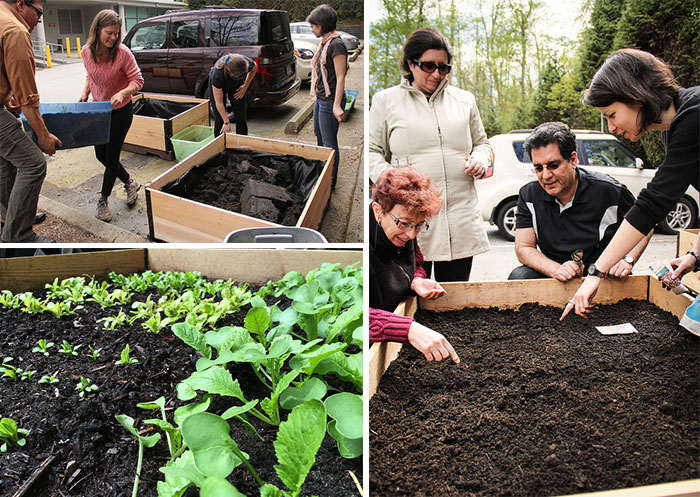
Prism’s Green Team turns a parking spot into a food garden
Now in it’s 8th year, Prism’s humble garden is a gathering place for outdoor meetings and breaks, while providing healthy snacks and habitat for the bees. Over the years, it has taken various shapes and been stewarded by various staff members. This year, the Prism Green Team renovated the garden beds and planted new perennials and chose to plant veggies that would be easy for anyone to harvest. The team also thought about how to make the whole process zero waste by using recycled containers to plant seedlings and by repairing the existing beds instead of replacing them.
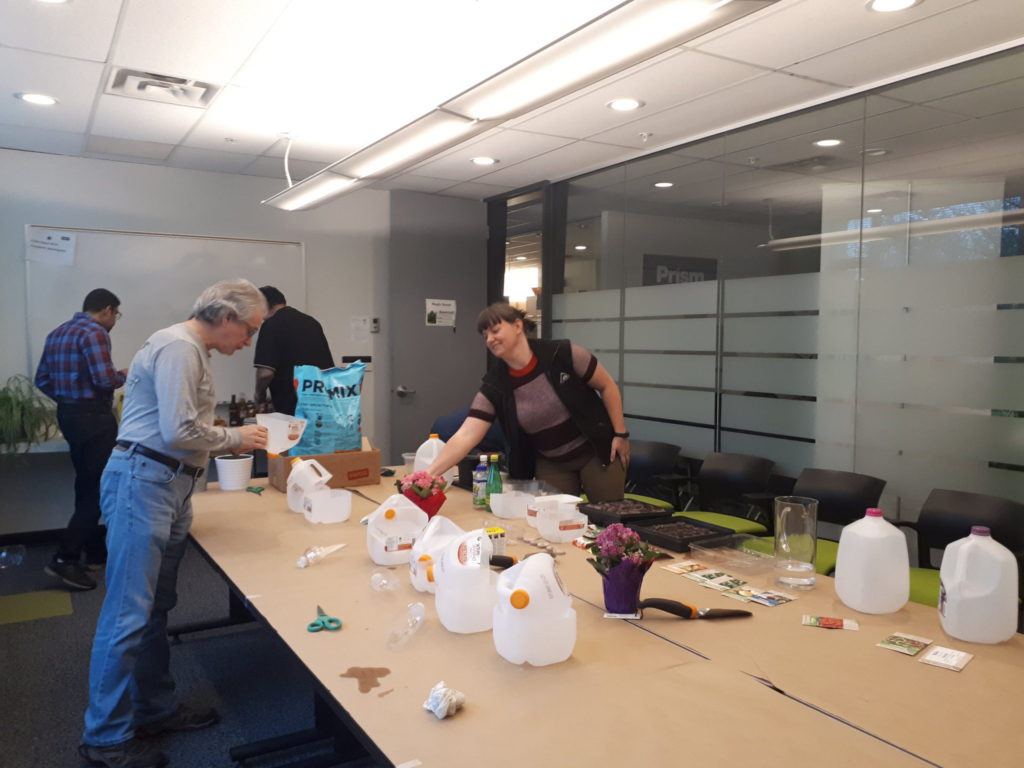
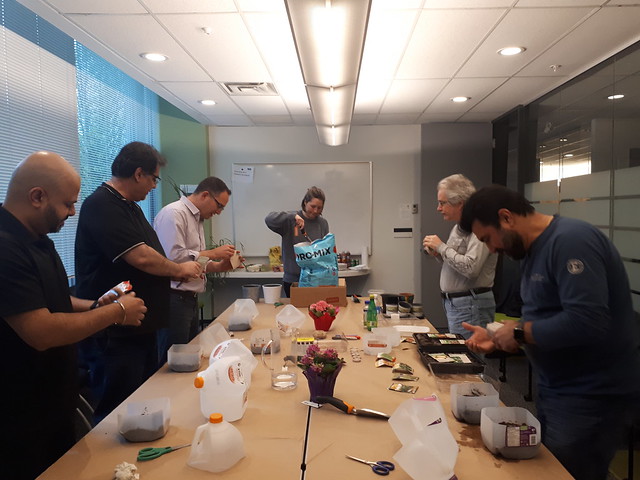
Towards Zero Waste
Prism’s Green Team repurposed old milk jugs and food containers to hold seedlings and make a mini greenhouse that sat by the window in the office. Every few days, Green Team members would tend to the seedlings and we all got to watch them sprout.
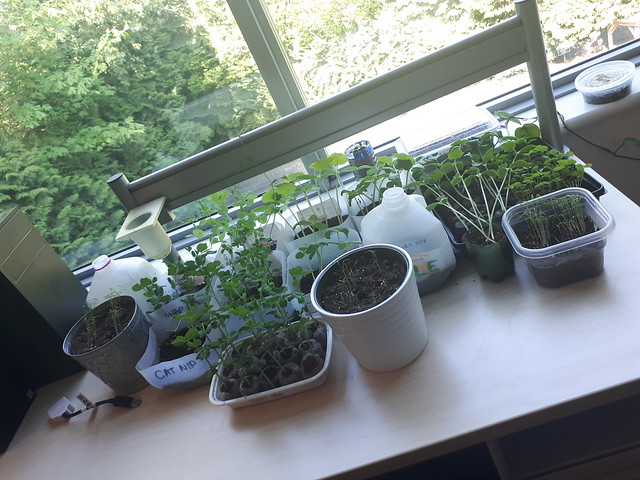
Planting seedlings in the renovated garden beds
Now several years old, the garden beds have withstood the seasonal changes, and a few brushes with cars backing up. Rather than replace them, the team acquired the necessary hardware to bring them back to life.
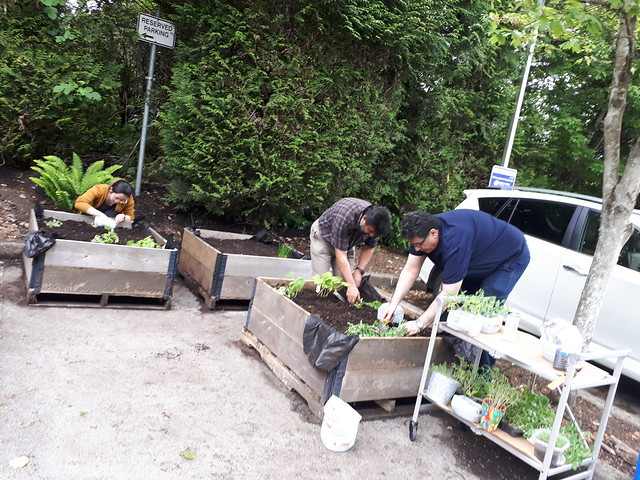
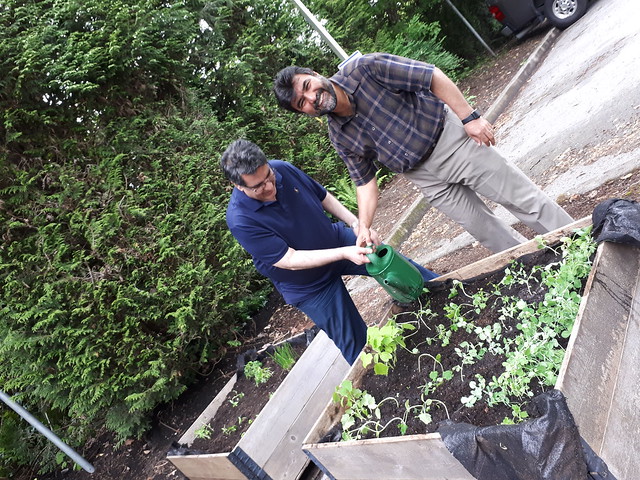
Flashback to the summer of 2014 when we went from plastic bins to the cedar garden beds that we still have five years later. That summer many staff lunches at company meetings were supplemented with fresh salads from our garden.