
Welcoming our Newest Associates
We are excited to share that we have five new Associates joining the Prism leadership team this fall. Prism Associates are individuals with the experience, expertise, and passion to support our clients in creating a greener, more energy-efficient world.
Each Associate takes on company-level responsibilities, leading different aspects of our business, from quality assurance to business development to employee engagement. Our Associates support the growth and development of our junior team members and are key to fostering our company culture of care and collaboration.
Our new Associates:
Tim Aske is a valued member of the Energy Team and maintains a high standard in client deliverables by carrying out technical reviews for Energy Team projects. He currently leads the Fault Detection Diagnostics, Recommissioning and Direct Digital Control services within Prism.
Sarah Colman is an integral part of the Sustainability Team, leading the Sustainability Strategy and Reporting Service areas. She will be working with the Marketing team to set the direction for Prism’s long-term marketing plan and leading the company’s B Corp assessment.
Adam Franklin currently leads Electrification and Electric Vehicle, Lighting & Lighting Controls and Power Quality Service areas at Prism. Clients know Adam as consistently delivering high quality work and acting as technical reviewer for electrical projects.
Lyn Papio has stepped into the role of the People, Culture and Operations Team Leader and has been instrumental in helping the company respond to the many challenges we faced in the last couple of years all while continuing to dedicate her energy to supporting the employee experience at Prism and PUMA
Ari Spiegel leads the Energy Audits and Training Service teams. As an avid teacher and enthusiast for energy management, Ari will also be providing leadership to Prism’s sister organization, PUMA, and supporting them in their business development efforts.
“We are very fortunate to have these individuals who are passionate and dedicated to their work join the leadership team at Prism. Each of them has demonstrated their willingness and ability to mentor others and share their knowledge to create value for our clients. Together, along with every Prism employee, we look forward to helping our clients make an impact.” – Robert Greenwald, Principal and President.
Learn more about our current opportunities and reasons to join the Prism team.
Making the Most of Rebates and Incentives
Financial support for energy conservation and climate action projects through rebates and incentives is a critical component of helping many projects proceed. However, without knowing which funding options work best for your project, it’s possible you may be missing out.
Rebate programs can help to offset 50-100% of the cost of an energy study and as much as $1M towards the cost of retrofits. Sometimes more than one incentive program can be applied to a single project, while some programs may offer less for a study but more for implementation. Understanding these programs and which one will offer the most value to your project can be confusing and time consuming.
Although many of us are aware of various rebates and incentive programs that support energy and carbon reduction projects, learning about new programs and keeping up to date with changes is important if we want to maximize the funding available and get projects moving.
Some tips from Prism’s team when you’re looking at rebate and incentive options include:
- See if the program will offer an incentive for implementation of measures once the study is complete if you’re conducting a study first.
- Consider whether the program favours energy savings or carbon reduction and how this aligns with your priorities.
- Check that the program timeline works for your project and aligns with your internal funding schedule.
- Understand any measurement and verification (M&V) requirements and the impact of equipment performance on the incentive.
- Read the fine print – see if there any claw backs associated with not implementing the project.
While the Prism team can help educate and navigate you on various programs, there are also several useful online resources available to help. Below is a summary of our ‘go to’ resources you might find beneficial:
| Resource | Sector |
|---|---|
| Comprehensive incentive list by province and sector | All |
| BC Community Climate Funding Guide | Local governments & Indigenous Communities |
| Community Energy Association – Funding Guides BC and Alberta |
Local governments |
| CleanBC Better Buildings | All |
| BC Hydro Programs & Incentives | All |
| FortisBC Programs & Incentives | All |
| Goverment of Canada Climate Adaptation Funding | All |
Here’s what some of our clients have shared about the value of finding the right incentive program:Now is a great time to consider possible funding contributions to your projects through rebates and incentives. Momentum continues to build around deep carbon reduction in the built environment, and so too does the funding programs and incentives out there to help support it.
“Prism has been instrumental in maximizing the City of Port Moody’s investment to reduce emissions from civic facilities. They identified several funding options for the City to consider and worked with staff to customize an approach that maximizes the City’s investment and meets all project goals. Prism has led the City’s team through the funding application by researching and laying out application requirements, tracking application components, and preparing key documents.”
-Laura Sampliner, Sustainability and Energy Coordinator, City of Port Moody
“The Regional District of Okanagan Similkameen (RDOS) has found the custom study from Prism and the FortisBC incentives invaluable to progressing energy saving actions in corporate buildings. Incentives offered for the study and the incentives in the study have received high-5s and smiles from the engineering and finance departments. Without these incentives, it is doubtful an engineering report of this calibre would have been affordable.”
-Jeremy Dresner, Senior Energy Specialist, Regional District of Okanagan Similkameen
Depending on whether you are considering funding for a study only, or study followed by implementation, the best incentive program to maximize your overall contributions might not be the most obvious path.
Contact Sam Thomas if you’re unsure about which funding path to pursue, and we’d be happy to help guide you in the right direction!
Operators Training Results in $140,000 in Energy Savings
“As a technician, being able to implement energy saving activities and knowing how to make adjustments for sustainability in our buildings has been very rewarding,” says Bob DePaiva, Colliers Building Operator.
In 2019, Prism worked with the Colliers Energy & Sustainability Manager and General Vancouver Operations Manager to design and deliver the “Colliers Building Operator Challenge”. The year-long challenge provided quarterly training sessions, ‘take-home’ exercises, and participation prizes. It gave operators the opportunity to come together to learn, discuss, and share ideas about saving energy in their buildings. The combination of training, discussion and easy-to-implement actions meant operators not only learned how to identify and implement energy saving strategies, they were inspired and motivated to apply these learnings.
Before Prism designed the challenge and accompanying training sessions, a survey was conducted to understand operator needs and desires as well as what would motivate them to participate in the upcoming challenge.
“We believe that a thorough understanding of our audience is key to developing initiatives that will engage and educate. Our survey results allowed us to narrow in on topics that were most relevant to the group and to structure the challenge in a way that positioned operators to ‘do the best job they can’. This was the number one motivator operators identified for participating in the challenge,” shares Christine Obee, Sustainability Engagement Specialist at Prism Engineering.
Once the challenge wrapped up, PUMA, a web-based utility monitoring software, was used by Nicky Arthur, Energy & Sustainability Manager at Colliers to analyze energy savings. Evidenced by energy usage data and the absence of other capital projects that could have reduced emissions, Nicky concluded that the bulk of these savings were attributable to low and no-cost actions, such as those covered in the training sessions.
“We wanted to measure the actual savings that could be attributed to actions by our operators. Based on feedback from our team, we realized that many of the measures they implemented had a significant effect on gas consumption – things like altering Direct Digital Controls (DDC) schedules and setpoints,” shared Nicky.
When comparing 2019 (with the Operator Training Program in place) to 2018:
- Electricity consumption savings increased from 10.5% to 12.8%
- Natural gas consumption savings increased from 0% to 4.8%
- Overall energy consumption savings increased from 7.5% to 10.3%
- Overall energy cost savings increased from 10.2% to 12.5%
The estimated energy saving attributed to the building operators after their training is 2,584,372 ekWh (9300 GJ), or 2.8%. This is equal to saving over $140,000 annually. Emissions saved equals 264 tCO2e.
Climate Action Planning and Strategies for Low Carbon Resilience
At Prism we recognize that the key to our success is our people. This fall, we are fortunate to have another passionate, experienced sustainability professional join our team.
Julianne Pickrell – Barr joins the Sustainability Team as our Climate Action Specialist.
Julianne will be helping our clients tackle the complexities of both climate change mitigation and adaptation. Julianne will be helping organizations assess their GHG emissions footprint, identify reduction opportunities, and develop practical, action-based sustainability and climate action plans. At the same time, she will be helping organizations conduct climate hazard assessments, identify low carbon resilience strategies and develop adaptation plans for future climatic conditions.
“Julianne brings a unique combination of knowledge and skills to our team. With a background in marketing and extensive experience in energy management, zero-emission vehicle adoption, GHG tracking and reporting, policy evaluation and climate action planning, our clients will truly appreciate her ability to engage and educate as a subject matter expert,” shares Sarah Smith, our Sustainability Team Lead.
When asked about joining Prism, Julianne reflects that “I was drawn to Prism because it has an excellent reputation in the industry and is known for doing interesting and impactful work. I look forward to working with diverse organizations to meet their climate action goals. During my time as the Manager of Energy and Environmental Sustainability for the Abbotsford School District, I had the opportunity to establish and work on a variety of collaborative, cross-departmental teams which helped to guide the district’s overall environmental sustainability goals and increase participation in environmental sustainability initiatives. I found the process of strategic planning, implementation and coaching very rewarding and look forward to applying my skills at Prism.”
Julianne is currently completing her master’s degree in Resource Management (Planning) and is also a member of the Sustainable Transportation Action Research Team (START) at Simon Fraser University. Her research project is focused on zero-emission vehicle and alternative fuel vehicle adoption in organizations.
Outside of the home office these days, Julianne enjoys biking, cooking, gardening, and back woods camping – “the kind where nature is all around us and the silence is deafening” she adds.
In particular, she enjoys being able to grow her own food. Most recently, her garden has yielded over 30 lbs of potatoes and a variety of apples and berries.
Julianne grew up in British Columbia and spent a lot of her time in the great outdoors. This has instilled in her a lifelong desire to find ways for humanity to better coexist in balance with nature.
Learn more about our current opportunities and reasons to join.
Engaging Employees in Sustainability: 4 Insights from Supporting the Government of Canada
Real Property Services (RPS), a branch of Public Services and Procurement Canada (PSPC), hired Prism to support their efforts to engage employees in embedding sustainability actions into operations across Canada.
A multi-year project from 2019-2021, we developed a Communication Plan and supporting employee engagement materials to help RPS employees understand what sustainability actions they need to integrate into their work. Based on our time working together, we’ve pulled together four reflections that we believe are important for any successful sustainability strategy and implementation project.
The 4 insights
1. Change is a process, not an event.
At its core, integrating sustainability commitments into organizational practice is a change management project. We know that change doesn’t happen overnight; individuals will move through change at their own pace.
For this project, RPS is asking employees across the country to make changes to current work processes that will take time, resources and require critical thinking and problem solving. We worked with RPS to develop communication materials and a plan that provide employees with the information and support they need to move from awareness to execution.
2. Customize communication to your target audience(s).
Successfully implementing a change management project depends on effective communication and engagement with the people involved in the change. In the case of RPS, we segmented the audience into three groups: senior leadership, middle management and teams.
Research and experience tell us that senior leaders provide the authority and credibility necessary for successful change. They must be active and visible sponsors. Middle management is the group most likely to resist change, but also best positioned to coach and influence their teams. Individual employees and teams are at the heart of organizational change and, ultimately, a project’s success is dependent on their ability to adopt new ways of working.
At RPS, we consulted and learned about each of these stakeholder groups to understand their motivators and barriers to support the integration of sustainability actions. Based on the results, we tailored communication and engagement initiatives to speak to the right person, with the right message, at the right time, in the right place.
3. Design with the end-user in mind.
We developed all of our communication and engagement materials for the project with the end-user in mind. Through consultation and collaboration with employee groups across the country, we asked questions to understand how departmental processes work, what challenges employees foresaw with the rollout, what support systems would be helpful, as well as perspectives and attitudes about the project and its impact. The result is a plan and suite of materials that employees already support and are practical for them to use.
4. Collaborate and iterate.
Working with RPS felt like a true team effort. Instead of delivering lengthy drafts based on assumptions about content and direction, we collaborated during weekly working meetings to iterate content and make decisions. And, as we describe throughout this article, we engaged with stakeholder groups across the country to ensure we made informed decisions that listened to our audiences’ needs. The result is a plan and suite of materials that we are proud to see implemented across the country.

Prism is here to support your organization’s success.
Our experience with this project highlights what we see time and time again: people are at the heart of change. At Prism, we’re committed to working with organizations to develop and implement sustainability strategies that engage people every step of the way.
Interested to learn more?
Connect with the SEM Team
Recent Heatwave Renews Urgency in Facility Planning for Climate Adaptation
The recent heatwave experienced across the Pacific Northwest saw temperatures reaching 40 C in Vancouver, and even higher in the interior region. Based on climate modelling, the temperatures we recently experienced will become the norm by 2070. While this date may seem like a long way off, the reality is the buildings built today will still be in operation in 2070. As we come to experience more and more extreme weather events, we need to adapt our buildings to be resilient.
Many of the cooling systems in our facilities were designed and installed based on historical design conditions and struggle to maintain space comfort during these extreme events. Some buildings in Coastal BC regions, such as elementary schools and residences, are not equipped with cooling systems altogether. The cooling needs of our facilities is expected to increase to six times that of what it is today by 2070. Assessing buildings for resiliency to future climate conditions will ensure occupancy safety and service continuity.
Climate Risks to BC
The increase in wildfires in recent summers also means indoor air quality becomes a critical part of health and safety in our buildings. Reducing outdoor air volumes to decrease smoke particulate intake contradicts best practices for COVID-19 where we should be ventilating as much as possible. Improving air filtration therefore becomes a solution for adapting to increased wildfires as well as mitigating the transmission of communicable diseases.
This graphic below provides an overview of the risk assessment findings for 15 scenarios of climate risks to BC:

Source: Ministry of Environment and Climate Change Strategy (2019). Preliminary Strategic Climate Risk Assessment for British Columbia – Summary of Results
https://www2.gov.bc.ca/assets/gov/environment/climate-change/adaptation/climate-risk-summary.pdf
You will see that heatwaves and seasonal wildfires are very likely to continue and cause major and nearly catastrophic consequences by 2050.
Climate Change Mitigation and Adaptation
Now more than ever, climate change mitigation and climate adaptation both play a synonymous role in reducing the impact of climate change, as well as getting our facilities ready to adapt to increased extremes.
Climate Change Mitigation is the process of reducing the impact we have on the changing climate, particularly through the reduction of greenhouse gas emissions.
Climate Adaptation is the process of preparing ourselves for the known and anticipated impacts of climate change.
Adaptation Strategy
The BC government is preparing to address resiliency for public sector infrastructure and Prism is supporting this initiative as part of a group of consultants to the Climate Action Secretariate as well as direct services to our public sector clients.
Below are suggestions from CleanBC’s Climate Preparedness and Adaptation Strategy for 2021-2022:
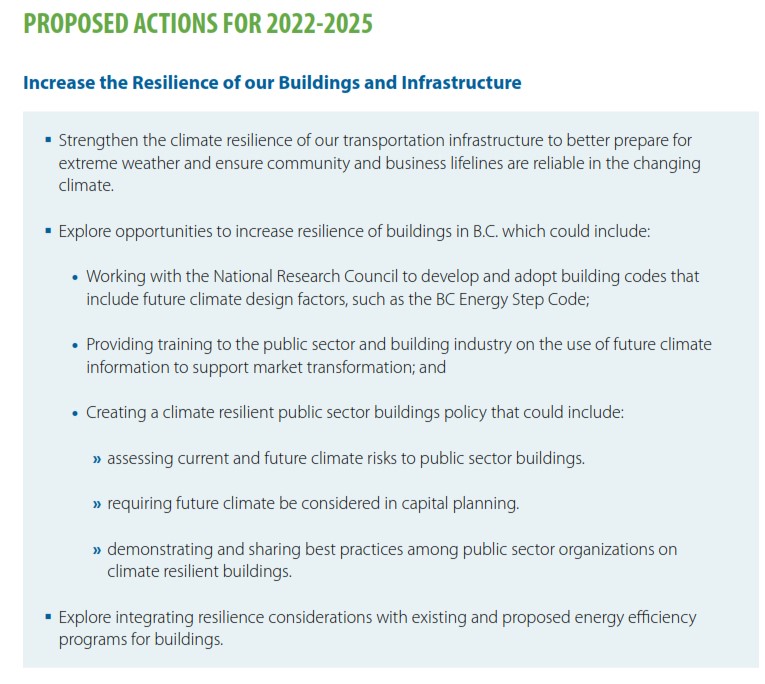
Source: CleanBC (2021). Climate Preparedness and Adaptation Strategy: Draft Strategy and Phase 1 Actions for 2021-2022. https://www2.gov.bc.ca/assets/gov/environment/climate-change/adaptation/cpas_2021.pdf
Prism is ready to help you navigate the myriad of options related to low carbon resiliency and climate adaptation, helping to keep your facilities safe and comfortable into the future for your tenants, staff, and communities.
Learn more about our climate change adaptation services here or contact us directly at info@prismengineering.com
Congratulations to the First Prism Engineering Award Winner at Langara College
As part of our 30th anniversary celebration last year, Prism staff voted to fund the Langara 49 Women in Science Scholarship program. This scholarship program provides philanthropic support, resources, and mentorship to prepare female students for a successful STEM career. The Prism Engineering Award was established last year as part of this program.

We are proud to congratulate Aislinn Kiel as the first successful recipient of this award for 2021. Aislinn is an Engineering student who demonstrates a passion and commitment to sustainability not only through her studies, but through a produce preservation program she co-founded in 2018. In a single year of operation, Aislinn and her teammates redirected over a thousand pounds of food from landfills and provided hundreds of meals to those in need.
“Every week we collected approximately 80 pounds of unsellable and excess fruits and vegetables from produce distribution companies and green grocers around Vancouver. This unwanted produce was then dehydrated and turned into healthy snacks available for sale to the community.
The profit from our program allowed us to support our community-focused ‘Food Share Program’ where leftover food from large events, such as banquets or conferences, was collected and delivered to homeless shelters and modular housing locations across Vancouver.”
Aislinn is currently working towards an Applied Science Diploma and aims to continue her studies in engineering or sustainability.
“I spend a lot of time worrying about my studies. I want to do well and put in a lot of time and effort. Being selected for this scholarship has given me such a boost of motivation and confidence as well as financial relief. It has been amazing to know that my work is being appreciated and recognized and that someone believes that its worthwhile to support my academic goals.”
It is extremely encouraging to learn about the work students like Aislinn and her peers are doing to reduce waste and support the more vulnerable in our community. We wish Aislinn the best of luck in her future endeavours.
Learn more about the Langara 49 Women in Science Scholarship program here.
Saving Energy and Improving Building Operations
As our team continues to grow to meet client needs, we are excited to announce that Richard Senez has joined the Prism team this past spring as our newest Energy Management Professional.
Richard brings with him a passion for sustainability along with over a decade of experience in energy management, HVAC systems, building services and project management in both Canada and the UK.
Richard has enabled teams to successfully deliver the highest standard in commercial building maintenance, performance audits, energy projects, and the deployment of innovative analytical platforms. He has also led Energy Management Systems implementation to the IS0 50001 standard, corporate sustainability initiatives, and comprehensive building optimization programs.
It was his work as an electrician early in his career that gave Richard first-hand experience on HVAC systems and controls in commercial buildings.
“I became very aware of the opportunities to reduce energy waste and saw the impact I could have operationally. This work sparked my interest in the energy efficiency sector and eventually led me to complete the Energy Management Professional course through the Energy Institute and ultimately to the master’s program in Energy, Environmental Technology and Economics at City, University of London.”
To start, Richard will be working with the Energy team to support the Continuous Optimization Program, a joint offer from BC Hydro and FortisBC which supports organizations in saving energy and improving operations in large commercial buildings without having to undertake a major capital investment. The primary focus of the program is to improve the efficiency of the most energy-intensive systems, such as HVAC, with simple, low-cost solutions.
“The sustainability ethos has always been a part of my nature. We are a flexitarian family, we don’t own a car, and we just try to live and raise our children in a sustainable way. Prism’s alignment with sustainability is what really drew me to the organization.”
“Richard brings to Prism a unique combination of hands-on experience and training in building performance and energy management. I am confident our clients will benefit from his expertise as well as his enthusiasm for energy efficiency and optimization,” shares Iram Green, our Energy Team Lead.
When not working, Richard enjoys golfing, skiing and biking with his young kids and his wife. He has also been re-learning the piano and sharpening his cooking skills since the start of the COVID-19 pandemic.
Partnering to Support Women in Need
In recognition of the many challenges women in this community face, Vancouver-based businesses, Prism Engineering and RATIO, partnered up to provide in-kind support to help the Downtown Eastside Women’s Centre open a new second, much needed shelter for women.
The Downtown Eastside Women’s Centre provides a safe, nonjudgmental environment for women from all walks of life who live or work in the Downtown Eastside.
It offers women supportive surroundings and services for women, including shelter, refreshments and meals, telephone and computer use, safe and clean washrooms and showers, access to clothing and toiletries and medical supplies, housing and referral counselling services, and advocacy services.
For many women who live or work on Vancouver’s Downtown Eastside, the COVID-19 pandemic and its related health restrictions have intensified the challenge of accessing safe, supportive spaces and community services.
“Our community of women has been exasperated and isolated even more so than most by the pandemic as services and access to spaces have been limited,” says Downtown Eastside Women’s Centre Facilities Coordinator Lila Gaylie. “Many services and shelter spaces were closed during the height of the pandemic, which had women facing the stress of the pandemic on top of the stress of finding a safe space.”
Physical distancing requirements put in place by provincial health authorities to slow the spread of COVID-19 also limited access to the centre’s women-only spaces – even as the need for those spaces skyrocketed.
“The COVID-19 pandemic has disproportionately affected some communities and put many people in unsafe situations with few options,” says Prism Engineering President Robert Greenwald. “We saw this project as an opportunity to give back and make a real difference to the community during this time of need.”
Prism worked with RATIO Architecture to fast-track the renovation of the shelter to meet high demand and provide women with safe, warm indoor accommodations during the winter. Construction on the former retail space began January 18, 2021 and with the support of the City of Vancouver in the permit process, the centre was open for use just a few weeks later, in early February.
The new space, which includes washrooms, kitchen areas, a reception area for staff, and leisure spaces for women to relax and receive support services, helps alleviate the need. It has allowed the Downtown Eastside Women’s Centre to expand its hours and services, and serve more women in the community by giving them a safe place to go that is off the street and out of the line of gender-based violence.
“Prism Engineering and the other groups helping us on this project made a world of difference in ensuring a smooth process and that things were done right, despite the incredibly tight timelines,” says the centre’s Fundraising & Communications Coordinator Ali Omelaniec. “We are so grateful for their generous assistance in providing a safe, functional space that will provide shelter and safety for women in the Downtown Eastside during such a tough time in the community.”
“This pandemic has very clearly shown us that we need to support each other,” Greenwald says “and I encourage others to consider what they can do to help those in our community who need our support the most.”
For information on how to donate to the Downtown Eastside Community Centre, please visit https://dewc.ca/donate.
To find out about other registered charities in B.C. that provide vital services to people in need, visit https://www.canadahelps.org/en/explore/charities/category/social-services/region/BC/.
Welcoming Our Newest Strategic Energy Management Coach
We are excited to welcome Joshua Caplan as Prism’s Strategic Energy Management (SEM) Coach this spring.
SEM is a holistic approach to energy management that enables businesses to achieve long-term and persistent savings. Instead of managing energy saving projects one by one, SEM provides the tools to manage energy in a coordinated and strategic way across an organization — helping businesses increase profitability, create a competitive advantage, and gain greater resiliency.
This is achieved by using low-cost behavioural, operational and maintenance related opportunities.
Josh will be working with Prism’s team of SEM coaches and energy management professionals to support industrial and commercial clients with their strategic energy management programs.
As a Certified Energy Manager, Joshua has valuable hands-on experience with energy efficiency for buildings, low carbon fleets, GHG accounting and reporting, project management, as well as financial analysis. He has worked in the field of environmental sustainability and energy for over 15 years, both as a consultant and within organizations and has trained and coached over 100 organizations to help develop their GHG inventories and mitigation plans.
Most recently, Joshua managed ICBC’s environmental sustainability team and was responsible for defining and carrying out their environmental sustainability strategy including resource efficiency, GHG targets and cultural goals. And as ICBC’s BC Hydro sponsored Energy Manager, Joshua developed and implemented the organization’s strategic energy management plan.
His interest in sustainability started at a young age.
“As a child growing up Montreal, I spent my summers canoe-tripping in Ontario and Quebec. It solidified my appreciation for the natural environment, our place within it, and our responsibility to protect the earth.”
What drew Josh to Prism was the organizational culture and the people he was already familiar with.
“Everybody I spoke to at Prism shares a commitment to sustainability and passion for addressing climate change. I look forward to supporting other organizations to become more energy efficient and less carbon intensive.”
“Joshua’s experience and expertise will help our clients evaluate and develop energy management practices to advance their sustainability goals. As an effective and engaging facilitator and coach, Josh leverages both his technical and communication skills to empower and motivate the people he works with to take action to reduce energy and carbon. I am excited for the work we’ll do together in the strategic energy management space,” our President, Robert Greenwald, shares.
Outside of work, Josh enjoys skiing, hiking, mountain biking, and is a brown belt in Brazilian Jiu-Jitsu. He is also a huge fan of all music, cooking, and playing board games.