
Bringing 25 years of experience to Prism
From opportunity identification and concept design to implementation and final review, mechanical projects at Prism often leverage the talents of a team of people through collaboration. Recently, we were fortunate to have Hamid Samani, P.Eng., LEED AP, join our mechanical team. “Hamid has a breadth of experience in the technologies and industries where we do the most work,” says Mechanical Team Lead Stephen Kooiman, “he is a key technical resource in supporting our team with detailed engineering designs.”
Hamid’s 25 years in the industry have encompassed a broad range of projects; he brings a wealth of accumulated experience and expertise to all projects and is adept at negotiating the complexities and operational parameters of working within commercial, educational, institutional, and residential developments. His experience includes sustainable design, energy compliance analyzing and energy modeling, project management, HVAC system design, plumbing and fire protection systems design, specification writing, and construction reviews. As a LEED Accredited Professional, he is dedicated to implementing sustainability in his work.
His interest in designing systems started at a young age, growing up in Iran, “My father was an electrical technician and I used to go work with him,” says Hamid, “then later at high school, I was pretty good at math and physics and that moved me down a path towards engineering.”
“Really it was just an interest in making and creating things—in the end, that’s what it’s all about,” he says.
Outside of work, Hamid enjoys gatherings with friends and family—his wife Maryam, daughter Sara (23 years old) and son Parsa (16 years old). He has also enjoys carpentry and home projects, having just finished putting in an irrigation system in his backyard.
It’s clear his curiosity is still fueling his work and he emphasizes that as an engineer you have to be continually developing your knowledge, “From new technologies to new codes and standards, we need to understand how to use them in our designs.”
Hamid says what drew him to Prism was the focus on energy saving, “Being in this industry you get to know how much building systems, especially mechanical systems, consume in electricity and fossil fuels. If we can design a system that uses less energy, there’s no reason we shouldn’t be doing so.” He adds, “”I’d like to keep this earth for the future!”
Since joining Prism, Hamid has already started working on implementing a heat recovery chiller upgrade project at a Vancouver hospital, and a chiller plant capital renewal and energy project for a BC mine with an anticipated energy savings of 60% for the chiller plant.
We’re grateful to have Hamid Samani on our team and we look forward to introducing more new staff in the coming months. We’re always on the lookout for talented people who share our core values. Find our latest postings here.
International Women in Engineering Day in June
Women currently account for only 13.1 per cent of engineers in Canada. With International Women in Engineering Day coming up on June 23rd, 2019, we’re taking the opportunity to reflect on how far we’ve come and how far we have yet to go as an industry.
Prism Electrical Designer Alison Bodine shares a few thoughts on being a woman in the engineering field in this short video clip.
How are we supporting women in engineering at Prism? There is more to be done and we are determined to be better.
Prism President Robert Greenwald shared these reflections:
Probably the most important part of our culture is how we treat all people with respect, regardless of our differences, including gender. We don’t differentiate between the work of a female or male engineer nor do we treat our co-op students, young Engineers in Training, or Professional Engineers differently based on gender. This applies to wages, responsibilities and opportunities. We do work with our staff with young families on how we can adapt their work life with a young family, and that typically does apply more to our female staff. We are also nurturing a “culture of care” where employees can feel comfortable bringing up issues or concerns.
We provide time at work for staff to volunteer at events that encourage girls and women to consider careers in STEM. It’s important that we do this throughout the year and not just during days or month to encourage Women in Engineering. Last year, we participated in “diversity circles” relating to the 30 by 30 initiative, a target by Engineers Canada to increase the ratio of newly licensed engineers who are women to 30% by 2030 (BC is at 15.2% now, Canada at 17.9%). According to Engineers Canada, “”thirty percent is universally held as the tipping point for sustainable change””. This diversity circle was focused on how educational institutions can support the initiative.
More recently, Prism signed up as one of 49 sponsors and members for 49Women in Science Circle, an initiative by Langara College designed to encourage and celebrate women in STEM. This will provide an opportunity for one of our women engineers to be part of a community of 48 other technical women. I expect that our whole company can benefit from these experiences.
In addition to women in STEM, we need to encourage women in leadership positions in our industry. At Prism, our leadership team is richer due to the participation of women. Various project lead and key client relationship positions are led by women and we are encouraging more women to get involved in leading service areas as we grow.
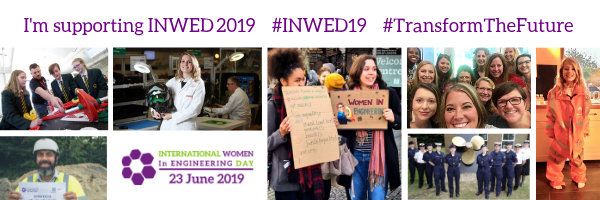
International Women in Engineering Day is an annual festival developed and coordinated by the Women’s Engineering Society (WES) to celebrate the achievements of women in engineering and inspire younger generations. Established in 2014 as a UK-wide event, INWED went global in 2017 with international support.
Find resources for organizing an event via www.inwed.org.uk/resources.html
What it means to work at Prism Engineering
If you walk into the Prism office on any given day, you’ll see the energy efficient technologies we’ve installed, and you’ll also get to see the people behind the projects. Over the years, we’ve been fortunate to work with dedicated people who we’re proud to have both as clients and staff. With our then Senior Mechanical Engineer, Duane Mattson, approaching his retirement after 17 years with Prism, we started thinking about sharing some of the things that make Prism’s culture unique.
Early this year, Prism staff, Duane, Faisal, Christine, Alison and Joany, generously sat down to reflect on what it’s like to work at Prism and what motivates us as a company to make a difference.
So what defines that culture?
“It’s hard to describe,”” says Prism President Robert Greenwald, “but I think there are five things that stand out.” Here’s what he shared:
- When we ask people what they like most about Prism, the top answer is always the people. Being part of Prism provides us with connections and a work community. We will continue to nurture this sense of family, both within teams and between teams.
- Also high up there is the feeling people have about making an impact by doing meaningful work. We can see the results of what we do not only in terms of saving energy but also in terms of modernizing buildings and supporting organizational change. We will continue to find interesting and challenging work to give our staff the opportunity to grow with us.
- It may be easier to show that you care as a smaller company but we will continue to listen, to be attentive and thoughtful about the needs of our staff. Through open communication and accessible leadership we will strive to improve and address any concerns that arise.
- Our culture also includes a drive for performance. We often have deadlines and workload pressures. We will continue to balance the need for deliverables and your work life balance. We are not in it for a sprint, but rather for the long term.
- We have developed an entrepreneurial spirit to get here. We have developed new products like PUMA, programs around voltage optimization, services in Sustainability, and now Strategic Energy Management. We will continue to pursue these opportunities and give our staff opportunities for growth and innovation through collaboration and teamwork.
“Our culture is created by every person that works at Prism,” says Greenwald, “we are excited by our team.”
We’re always on the lookout for talented people who share our core values. Find our latest postings here.
A few photos from behind the scenes in December:

Join PUMA’s Spring Workshops
There are a several events coming up in the next few months that we are hosting and participating in.
- May Workshop: Burnaby, BC on May 16th, 2019
- EFMA-BC Tradeshow: Penticton, BC May 28th to 30th
- BOMA QBT: Lunch presentation June 5th, 2019
Please contact duncan@prismengineering.com for more information or details of how to join us.
Growing healthy and well
At Prism, we understand that supporting health and wellness is an integral part of managing a company and enabling staff to thrive. Research shows that investing in health and wellness programs leads to better employee retention, productivity and even sense of purpose. While Prism offers comprehensive extended health benefits to employees, “We knew more could be done, and at the same time wanted to provide opportunities for our staff to be part of leading new initiatives in the office,” says Sarah Smith, Prism’s Sustainability Team Leader and Director of Employee Experience.
Sparking new ideas
In 2017, several Prism staff led a ‘spark group’ to help jumpstart and pilot a few ideas towards health and wellness. With folks from different teams in the company, the group started things off by coming up with a collective understanding of what health and wellness meant. Out came the flipcharts, and in the discussion, the group gravitated towards two areas, physical health and mental health, while acknowledging this was just one way of linking things together.

Learning new techniques to reduce stress
BC Cool Campuses Campaign underway
When sustainability leaders from local post-secondary institutions met to learn and share insights at the Energy Wise Network Summit on November 15, little did they know they would be working together to launch a new collaborative campaign to save energy. The idea for the BC Cool Campus Challenge arose in response to the natural gas pipeline rupture near Prince George which led FortisBC to ask everyone across the province to conserve wherever possible.
While the pipeline has since been repaired and the crisis has lifted, the BC Cool Campus Challenge is helping people rethink how we use energy. Organizers aim to use this challenge to start a conversation on energy dependency and resiliency and see it as an opportunity to demonstrate climate leadership.
With the majority of energy consumed on campuses going towards heating and cooling buildings, turning down the heat even slightly can have an impact. “More heat and hot water means more natural gas use, which means more greenhouse gas emissions,” explains James Gordon, Environmental Programs and Research Coordinator at TRU. “Although BC is blessed with relatively clean power, using natural gas is still burning a fossil fuel. We can all do more to do our part and reduce our use.” Along with adjusting the thermostat, the campaign is also focusing on gathering pledges and encouraging simple actions like wearing warm layers, taking shorter showers, and washing clothes in cold water.
The BC Cool Campus Challenge launched on January 7 and runs to the end of February. Participating institutions include: Simon Fraser University, University of British Columbia, University of British Columbia Okanagan, British Columbia Institute of Technology, Selkirk College and Thompson Rivers University.
The winner will be the institution that collects the highest percentage of energy-saving pledges from staff, students, and faculty, and the winner will receive a branded clothing item from each of the participating institutions and be crowned ‘BC’s Coolest Campus!’. To help keep more people warm this season, on behalf of the participating institutions, the winning team will donate all the warm clothing items to a local charitable organization.
Over 2000 online pledges have been collected to date. While the campaign introduces some friendly competition, organizers say it’s really about collaboration and working together towards a common goal. James adds, “We’ve been able to exchange tips and it’s been helpful to think about how we can support each other’s efforts in the future.”
Follow the hashtag #BCCoolCampus for more updates and photos!
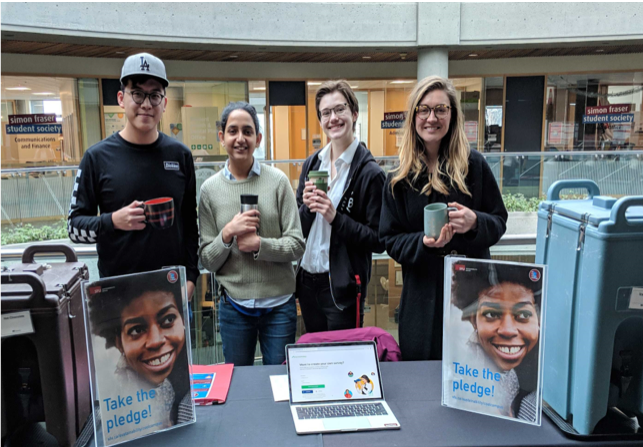
Photos: top – Students hold up their pledge actions at an event at UBC; bottom – students tabling at an event at SFU.
Did you know?
Small steps can make a difference. Here are a few ways small changes can add up (via FortisBC):
Residential
- Turning down the thermostat an additional three degrees when you need heat, can save an average of eight gigajoules of natural gas per year. If 11 households did this simple action it could equal enough natural gas to heat one home for a year.1
- If each member of a four-person household shortens their daily shower time by two minutes, almost five gigajoules of natural gas will be saved annually. If a community of 100,000 households did the same, it could save enough natural gas to provide space heating for almost 5,000 homes for a year.2
Commercial
- If a 23,000 square foot office lowered its thermostat during office hours by three degrees, it could save enough natural gas to provide space heating for one household for a year.5
- If just one per cent of BC’s restaurants (about 140 restaurants) turned off their decorative natural gas fireplaces during the heating season, it could save enough natural gas to heat about 156 homes for a year.4
–
1Savings are approximate, assuming a thermostat setback of an additional three degrees for when heat is needed in a natural gas heated 2,300 – 2,600 square foot home located in a FortisBC service area. On average, a home this size consumes 90 gigajoules of natural gas annually for space heating.
2Savings are approximate, assuming a 7.6 litre per minute showerhead in a four person home with a standard efficiency natural gas storage tank water heater. Assumes a home consumes 90 gigajoules of natural gas annually for space heating.
3Assumes additional setback of three degrees for 10 hours each weekday, saving 90 gigajoules of natural gas over the heating season, enough to heat one average sized home for a year.
4A natural gas fireplace turned on 13 hours per day during the heating season would use 100 gigajoules of natural gas per year. Savings achieved when 140 restaurants turn off fireplaces saving approximately, 14,000 gigajoules of natural gas, enough to provide space heating for 156 average size homes in a FortisBC service area.
5Assumes additional setback of three degrees for 10 hours each weekday, saving 90 gigajoules of natural gas over the heating season, enough to heat one average sized home for a year.
Prism’s electrical team gets a boost
Led by our intrepid Casey Gaetz, who recently celebrated 25 years since joining Prism when it was a wee startup, Prism’s electrical team is full of characters. The team helps clients with everything from hospital lighting upgrades to designing solar photovoltaic systems. Over the years they’ve worked together to help keep us humble as a company and strive for innovation.
 To keep up with the growing diversity of projects and technologies, Casey is always on the lookout for talented people to bring new energy and insight to the team. “The industry is constantly evolving,” says Casey. “And it’s always exciting to have new people join our team who are as passionate as we are about saving energy and making a difference.”
We are pleased to introduce our newest electrical team members who shared with us what they enjoy about their work and what keeps them going outside of the office.

As a CAD specialist, Kaan Ertan has been immersed in a mix of projects, including improving designs for coffee shops, bank branches and government. Kaan completed his Bachelor of Applied Science in Electrical Engineering with a minor in Commerce at the University of British Columbia. His talent extends beyond design to music. Fluent in Turkish and Spanish, he loves to play flamenco guitar, graduated from the Royal Academy of Music, and won 2nd place in the Salsa World Tournament.
Kaan says he was drawn to working at Prism because of our purpose extends beyond, “the business aspect,” and that this is reflected in the work environment and the projects. “I like the idea of being able to learn different things every day and apply them in a variety of projects,” he says.

Jacky Wang is also a new addition to the electrical team having recently graduated with distinction from BCIT’s Electrical and Computer Engineering Technology Diploma program. Since joining he has been immersed all facets of lighting projects including site audits, database management, design, and reporting for clients. Reflecting on what he’s most excited about, Jacky says people are what he values most and that, “The electrical team in my pod, as hectic as timelines get, makes the space entertaining and light-hearted.”
Sustainability is also something Jacky takes to heart, from wearing down his basketballs before finally replacing them, to taking steps to avoid food waste. He adds, “The part I’m electrified about is making an impact. ‘Saving you energy’ is great to carry forward to the future generations.”
Top photo: Andrew, Adam and Faisal of Prism’s electrical team reviewing new luminaire models.
Meet Prism’s Principals & Associates
Then and Now
Prism was founded in 1990 by Brian O’Donnell who saw an opportunity to bring Energy Management and existing building upgrades at the start of the first BC Hydro Power Smart program.
Robert Greenwald joined the firm in 1991 and became President in 2006. Under Brian and Robert’s leadership, Prism has grown from a small handful of engineers to a company of over forty-five engineers, designers, and sustainability professionals, passionate about making a difference. We are proud to still be working with many of our clients who have been with us since our early years. We continue to work with passionate people across all sectors who share our vision for reducing environmental impact through technology, people and organizational change.
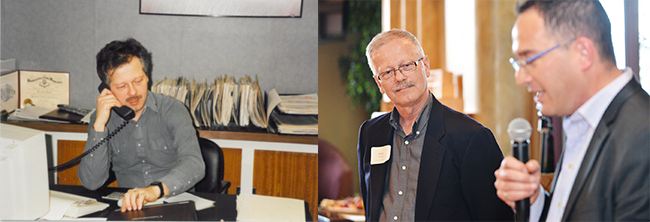
Photo: Prism Founder Brian O’Donnell talking with a client in Prism’s original Hastings office in Burnaby and with Robert at our 25th anniversary celebration in 2015.
Looking toward the future
Now nearing three decades in business, we have transitioned our leadership to give additional transparency and clarity to the roles, and to further build resilience into our company. Going forward, Brian will continue to play a key role in our Account Management and Client Relationships efforts.
We are pleased to introduce to you our Leadership Team, many of whom have been a part of Prism for many years and have been instrumental in stewarding our work and deepening our impact. Prism’s Principals provide strategic vision and leadership for the company. Associates have specialized knowledge and provide mentorship for key aspects of the company to ensure that we continue to deliver quality services to our clients.
Principals
Robert Greenwald, PEng, MBA continues as President with responsibility for operations, stewarding the leadership team, and providing the strategic direction of the firm. He brings passion and drive to the company’s long term success.
Casey Gaetz leads our electrical team and brings over forty years experience in the design of lighting, electrical distribution, metering systems, fire protection, and voice and data systems.
Iram Green, P.Eng., recently became the energy team lead with over ten years of experience in managing energy efficiency retrofit projects as well as training new energy professionals.
Sarah Smith leads our sustainability team and also has responsibility for the overall employee experience at Prism. Sarah is a sustainability strategist, facilitator, and engagement specialist.
Stephen Kooiman, P.Eng., leads our mechanical team and is experienced in designing HVAC, plumbing and fire suppression systems, chillers, and boiler plants, and low carbon designs.
Sam Thomas is branch manager for the Kootenays Office and is also leading our work in Alberta. Sam works alongside clients through all aspects of energy management and engineering projects.
Associates
Ken Holdren, P.Eng., has extensive knowledge of building systems and energy engineering. As Prism is OQM (Organizational Quality Management) certified with EGBC, Ken oversees compliance and quality assurance for our projects.
Duncan Wilcock leads our PUMA team including operations, development and marketing. PUMA is web-based software and services that help organizations get a grip on their energy costs by better monitoring and analyzing their utility use.
Our commitment
As we move into the next decade, energy management and sustainability and reducing our environmental footprint are more important than ever. We are inspired by recent developments in addressing climate change. In addition to reducing waste and improving efficiencies, we are expanding our design services to include the low carbon systems and applying renewables to offset energy use. We are also increasing our efforts to help organizations adapt to climate change and build resilient systems.
Part of a growing community
We are incredibly grateful to our staff who make Prism’s mission come to life. We value being a workplace that is fast-paced and highly collaborative with hundreds of projects on the go at any one time. Our staff is hard-working and motivated to continually strive for better, whether researching the latest technologies or helping mentor co-op students as future innovators.
We are also thankful to all of the people who we have had the pleasure of working with along the way–from the elementary school students who participate in ‘Lights off Lunches’ to the building operators learning how to optimize digital controls systems. And from the Property Managers upgrading their building systems to the Energy Managers developing strategic programs for energy management at a mine site.
We are excited about the future. Stay tuned.
If you have any questions, please contact Robert at Robert@prismengineering.com.
When learning never stops
A bitter-sweet event for Prism Engineering: Senior Mechanical Engineer Duane Mattson, who has helped make Prism a driving force in our industry, has decided to start to enjoy life at a more leisurely pace.
Duane decided to join Prism after retiring at the age of 65 from his work in government. No one would have guessed that Duane would have a whole second career of 17 years with us.
Over the course of his time at Prism, Duane worked on all kinds of mechanical projects that helped shape our company. One of his biggest projects at Prism was leading a $4.5 million retrofit over the tight 5-month construction period of the Air Canada Operations Centre. Duane stepped up to coordinate and determine ways of addressing site conditions, which included both asbestos and lead removal, adding complexity to the project.
With decades of experience in mechanical engineering, and a remarkable work ethic, Duane was an incredible resource for the company. When we sat down in December, Duane reflected back on being in a mentorship role, “(In the past) people helped me out, now it’s my turn to pass that information on to new employees so that they can have the same good life I’ve had and enjoy working.”
Duane plans to embark on new adventures in traveling, lawn bowling and hobbies, along with his wife. We wish him all the best and thank him for his invaluable contributions to our culture and expertise.
Best wishes from all of us!


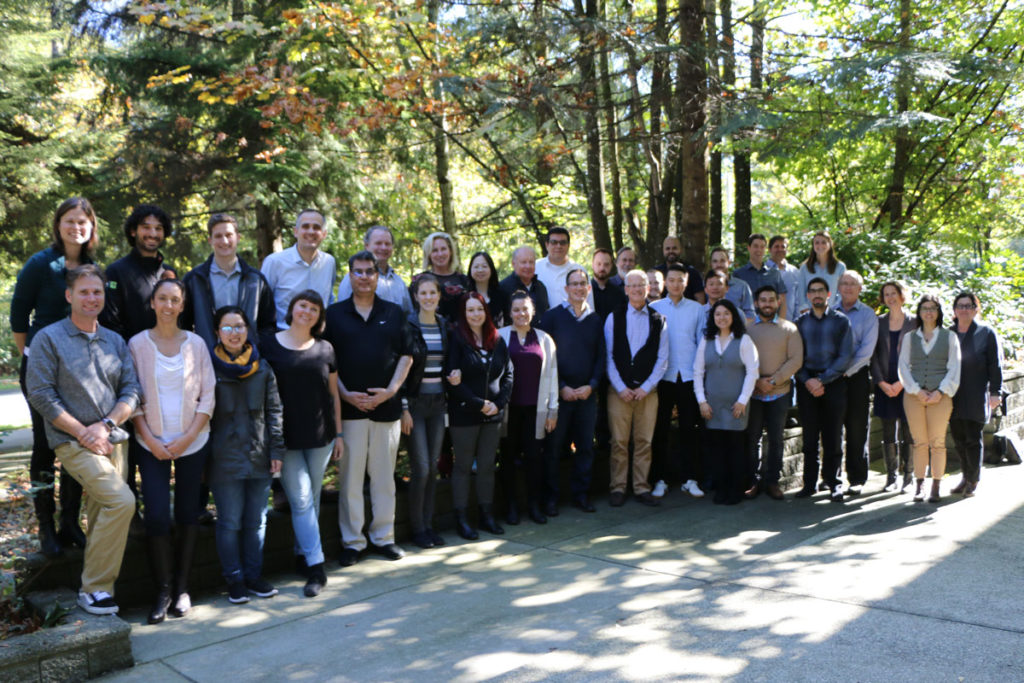
Photos: Top – Duane and the mechanical team reviewing drawings, Bottom – Tribute and celebration for Duane with all Prism staff
Warm wishes from the Prism team
Wishing every one a Happy New Year!