
What is RETScreen?
RETScreen is an energy management software tool developed by Natural Resources Canada (NRCan) that supports building owners with energy monitoring, energy use and generation simulation, cost estimates, and greenhouse gas analysis.
RETScreen Expert is available for free in Viewer mode, with premium features offered through a Professional subscription. The platform is widely used by public and private sector organizations, utilities, and educational institutions to support energy planning, performance tracking, and reporting.
Learn more about RETScreen: RETScreen – Natural Resources Canada
Prism’s RETScreen Services
Prism uses RETScreen Expert to support property managers, asset managers and institutional clients with energy and emissions analysis across individual buildings and multi‑building portfolios.
Typical applications include:
- Benchmark – compare energy use and emissions performance against similar buildings
- Prefeasibility – assess energy use and cost impacts, and emissions reductions of proposed energy and decarbonization measures
- Portfolio Planning – provide a portfolio level summary of proposed measures to support stakeholder prioritize and present short term and long term capital plans
- Performance – prepare energy models to provide monitoring and verification of energy and emission performance over time
RETScreen is used by Prism to apply a consistent, transparent analytical framework, helping clients make informed decisions based on energy performance, financial considerations, and emissions impacts.
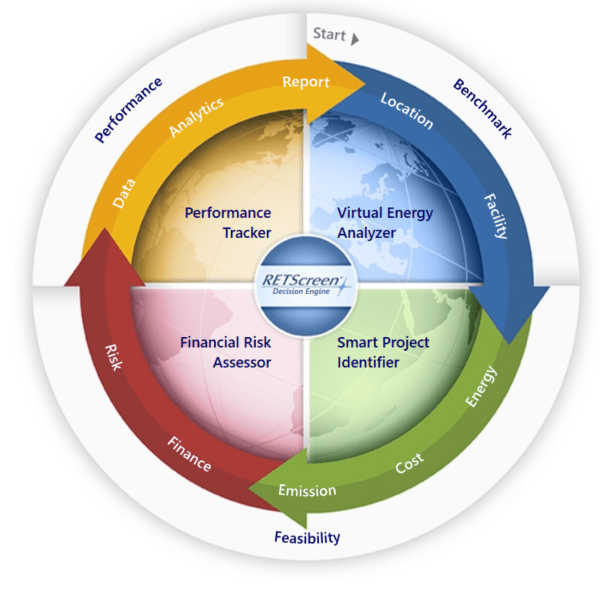 Facility-Level Analysis
RETScreen supports a structured approach to understanding energy use and improvement opportunities.
At the facility level, Prism uses RETScreen to:
- Compare facilities to similar building types and uses
- Evaluate the technical and financial viability of potential measures, especially when envelope improvements are assessed. Enclosure assessment using RETScreen allows us to evaluate quickly the potential systems interactions.
- Perform energy analysis, including heating and cooling performance models. These models are then used to establish baseline energy and emissions performance
- The RETScreen file is then shared with the client to support post‑implementation performance tracking in house.
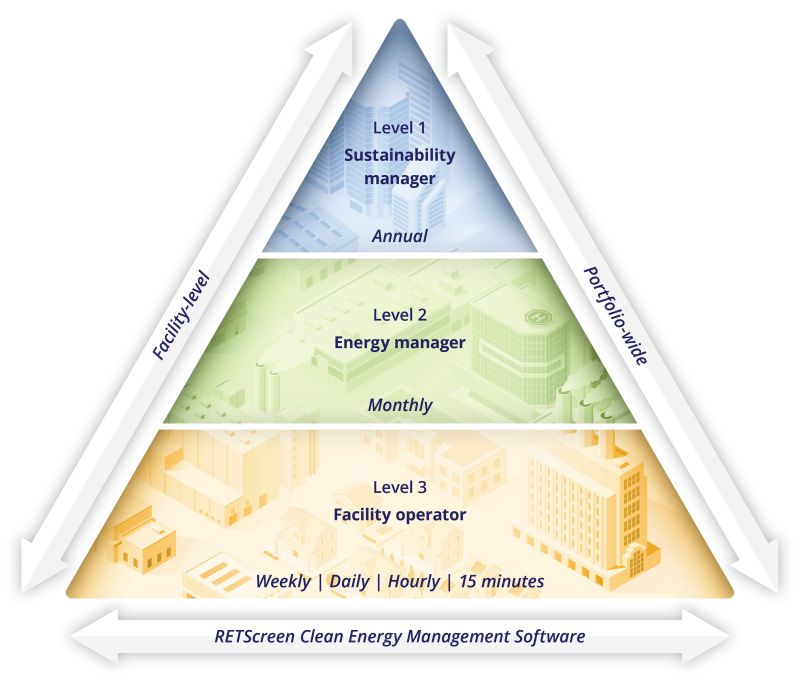 Portfolio-Level Analysis
RETScreen is well suited to organizations managing multiple buildings across a portfolio.
At the portfolio level, RETScreen can:
- Help client consolidate multiple RETScreen models into one reporting tool
- Compare performance across asset types or geographic locations
- Identify and prioritize buildings or measures across their portfolio for further action
- Provide portfolio‑level RETScreen files and outputs that clients can use internally to update assumptions, track progress, and support ongoing energy and emissions management
- Support high‑level energy, cost, and GHG reporting
Portfolio-wide analysis supports more strategic planning and helps organizations allocate resources where they can have the greatest impact.
Applications and Use Cases
RETScreen-based analysis can support a range of building types and ownership models, including:
- Commercial and mixed‑use properties
- Institutional and public‑sector facilities
- Schools and post‑secondary campuses
- Multi‑building portfolios managed by property or asset managers
The platform is commonly used in early‑stage planning, prefeasibility assessment, and ongoing performance monitoring.
The examples below illustrate different ways RETScreen has been applied by Prism on recent projects.
Example Applications: Municipal Building Portfolio

Client type: Municipality
Project context: Portfolio‑wide greenhouse gas (GHG) reduction pathway study for municipally owned facilities.
Prism supported a Canadian municipality in developing a GHG reduction pathway for a portfolio of 18 municipal buildings. The client requested the use of RETScreen to support energy and emissions analysis and to evaluate the impacts of potential measures across the portfolio.
Prism developed RETScreen building‑level models to establish baseline energy and emissions performance and to assess the energy, cost, and GHG impacts of both individual measures and combinations of measures within facilities. The analysis supported portfolio‑wide comparison and prioritization using a consistent framework.
The RETScreen‑based approach helped the municipality identify priority actions, compare scenarios across buildings, and understand how changes in assumptions affected progress toward corporate energy and emissions reduction goals—supporting informed decision‑making and long‑term capital planning.
Example Application: Federal Government Facility

Client type: Federal government organization
Project context: ASHRAE Level 2 energy study for an existing facility with limited energy utility data.
Prism supported a federal government client in completing an ASHRAE Level 2 energy study for an operational facility where detailed sub‑metering data was not available. To address data limitations and establish a clear understanding of energy consumption patterns, Prism developed a RETScreen model of the facility as part of the study.
RETScreen was used to analyze total energy use, develop an end‑use breakdown, and evaluate the energy, cost, and emissions impacts of potential energy‑saving measures. The model allowed Prism to assess individual measures as well as combinations of measures within the facility using a consistent and transparent framework.
The RETScreen‑based analysis helped the client compare upgrade options, understand the relative impact of different scenarios, and identify priority measures for implementation. The RETScreen models were provided to the client, along with guidance on how inputs and assumptions could be adjusted over time to support ongoing decision‑making and progress toward energy and emissions reduction goals.
Example Application: K‑12 School Facility Recommissioning

Client type: Public school district (K‑12)
Project context: Recommissioning study under a utility‑funded continuous optimization program for an existing secondary school facility.
Prism supported a large public school district in completing a recommissioning study as part of a utility continuous optimization program. The project focused on understanding heating system performance and identifying operational improvements to improve system efficiency and operation.
As part of the investigation, Prism used RETScreen to analyze the existing boiler plant load and assess the installed boiler capacity relative to the building’s peak heating demand. The RETScreen analysis supported development of a clear load profile, enabling comparison between actual building heating demand and boiler capacity.
The results were presented graphically to clearly illustrate system performance, including periods of low load operation and short cycling. This analysis helped support evidence‑based recommendations for operational improvements and potential retrofit measures to improve boiler plant efficiency and overall system performance.