
Recent Heatwave Renews Urgency in Facility Planning for Climate Adaptation
The recent heatwave experienced across the Pacific Northwest saw temperatures reaching 40 C in Vancouver, and even higher in the interior region. Based on climate modelling, the temperatures we recently experienced will become the norm by 2070. While this date may seem like a long way off, the reality is the buildings built today will still be in operation in 2070. As we come to experience more and more extreme weather events, we need to adapt our buildings to be resilient.
Many of the cooling systems in our facilities were designed and installed based on historical design conditions and struggle to maintain space comfort during these extreme events. Some buildings in Coastal BC regions, such as elementary schools and residences, are not equipped with cooling systems altogether. The cooling needs of our facilities is expected to increase to six times that of what it is today by 2070. Assessing buildings for resiliency to future climate conditions will ensure occupancy safety and service continuity.
Climate Risks to BC
The increase in wildfires in recent summers also means indoor air quality becomes a critical part of health and safety in our buildings. Reducing outdoor air volumes to decrease smoke particulate intake contradicts best practices for COVID-19 where we should be ventilating as much as possible. Improving air filtration therefore becomes a solution for adapting to increased wildfires as well as mitigating the transmission of communicable diseases.
This graphic below provides an overview of the risk assessment findings for 15 scenarios of climate risks to BC:

Source: Ministry of Environment and Climate Change Strategy (2019). Preliminary Strategic Climate Risk Assessment for British Columbia – Summary of Results
https://www2.gov.bc.ca/assets/gov/environment/climate-change/adaptation/climate-risk-summary.pdf
You will see that heatwaves and seasonal wildfires are very likely to continue and cause major and nearly catastrophic consequences by 2050.
Climate Change Mitigation and Adaptation
Now more than ever, climate change mitigation and climate adaptation both play a synonymous role in reducing the impact of climate change, as well as getting our facilities ready to adapt to increased extremes.
Climate Change Mitigation is the process of reducing the impact we have on the changing climate, particularly through the reduction of greenhouse gas emissions.
Climate Adaptation is the process of preparing ourselves for the known and anticipated impacts of climate change.
Adaptation Strategy
The BC government is preparing to address resiliency for public sector infrastructure and Prism is supporting this initiative as part of a group of consultants to the Climate Action Secretariate as well as direct services to our public sector clients.
Below are suggestions from CleanBC’s Climate Preparedness and Adaptation Strategy for 2021-2022:
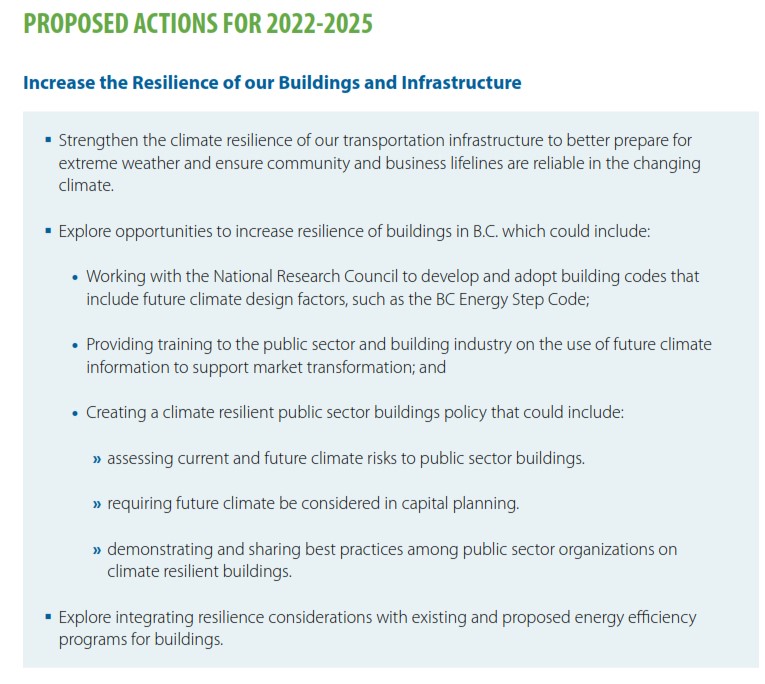
Source: CleanBC (2021). Climate Preparedness and Adaptation Strategy: Draft Strategy and Phase 1 Actions for 2021-2022. https://www2.gov.bc.ca/assets/gov/environment/climate-change/adaptation/cpas_2021.pdf
Prism is ready to help you navigate the myriad of options related to low carbon resiliency and climate adaptation, helping to keep your facilities safe and comfortable into the future for your tenants, staff, and communities.
Learn more about our climate change adaptation services here or contact us directly at info@prismengineering.com
Congratulations to the First Prism Engineering Award Winner at Langara College
As part of our 30th anniversary celebration last year, Prism staff voted to fund the Langara 49 Women in Science Scholarship program. This scholarship program provides philanthropic support, resources, and mentorship to prepare female students for a successful STEM career. The Prism Engineering Award was established last year as part of this program.

We are proud to congratulate Aislinn Kiel as the first successful recipient of this award for 2021. Aislinn is an Engineering student who demonstrates a passion and commitment to sustainability not only through her studies, but through a produce preservation program she co-founded in 2018. In a single year of operation, Aislinn and her teammates redirected over a thousand pounds of food from landfills and provided hundreds of meals to those in need.
“Every week we collected approximately 80 pounds of unsellable and excess fruits and vegetables from produce distribution companies and green grocers around Vancouver. This unwanted produce was then dehydrated and turned into healthy snacks available for sale to the community.
The profit from our program allowed us to support our community-focused ‘Food Share Program’ where leftover food from large events, such as banquets or conferences, was collected and delivered to homeless shelters and modular housing locations across Vancouver.”
Aislinn is currently working towards an Applied Science Diploma and aims to continue her studies in engineering or sustainability.
“I spend a lot of time worrying about my studies. I want to do well and put in a lot of time and effort. Being selected for this scholarship has given me such a boost of motivation and confidence as well as financial relief. It has been amazing to know that my work is being appreciated and recognized and that someone believes that its worthwhile to support my academic goals.”
It is extremely encouraging to learn about the work students like Aislinn and her peers are doing to reduce waste and support the more vulnerable in our community. We wish Aislinn the best of luck in her future endeavours.
Learn more about the Langara 49 Women in Science Scholarship program here.