
Celebrating Energy Efficiency Day
We’re honoured to be among the 436,000 Canadians working in energy efficiency today! Here’s to taking steps toward energy efficiency year-round with a short video on why having an impact is one of our core values. Read about what it’s like to pursue a career in energy efficiency and sign up for our email list to receive our quarterly newsletter.
Here are some of our favourite posts and memes from the day:
Winter is coming… #EETV #EEDay2019 pic.twitter.com/IeAHrHYGOp
— IL Home Performance (@IllinoisHP) October 2, 2019
15 years ago, lighting products consumed more energy in commercial buildings than any other appliance. The lighting community has worked for 15 years to flip this.
The chart shows lighting will soon be the lowest energy consuming appliance in commercial buildings. #EEDay2019 pic.twitter.com/DLAHQ4i2zx
— Illuminating Engineering Society (@The_IES) October 2, 2019
Happy Energy Efficiency Day! #EEDay2019 pic.twitter.com/N1I6NNtRFb
— CUB Illinois (@cubillinois) October 2, 2019
Energy Efficiency Day is here! Today is a chance to tweak your home and habits to reduce your carbon footprint and fight climate change. There are many simple ways to lower your energy consumption! Find ideas here: https://t.co/rv2nu250ig #EEDay2019 pic.twitter.com/NexyatYmr5
— NRDC (@NRDC) October 2, 2019
The meme game is strong for #EEDay2019 – what’s your favorite? #CleanEnergyWeek is fully on board for this #eeTV @ACEEEdc @MEEAee @LimeEnergy #energyefficiency #NCEW19 pic.twitter.com/QfaQmqVW4p
— National Clean Energy Week (@NCEWConf) October 2, 2019
Pursuing a Career in Energy Efficiency
Engineering is a constantly evolving field and, thankfully, it continues to draw in amazing people who care about having an impact. We caught up with three members of our Energy Team about why they chose to pursue a career in energy efficiency, and some of the experiences that shaped their interests along the way.
Lizz Hodgson is an Energy Management Engineer (EIT) with a mechanical design and project management background. She’s also a LEED Green Associate and is passionate about helping organizations save energy. An avid splitboarder and trail runner, Lizz says she was drawn to the mountains and moved a few years ago from Ontario. Now she’s a member of the Alpine Club of Canada and tries to get outside whenever she can along with her 2-year old dog and adventure buddy.
At Prism, you’ll find her busy working on energy studies and recommending measures to help buildings perform better through optimizing controls or equipment retrofits.

“”I wanted a career where I felt like I was directly contributing and in an industry that has a positive impact on the world. Addressing climate change is a real challenge, and as an engineer I want to use my skills to be a part of the solution. Prism is one of the leading energy management companies in BC. I couldn’t pass on the opportunity to apply to Prism when I saw the job description! Two things make work feel rewarding for me: feeling impactful and building relationships. The Energy Team is all about helping reducing energy consumption and getting to work with a variety of clients.”” – Lizz
Alec Suriyuth also hails from Ontario and, having recently moved, he’s excited to be diving into a whole new city and part of Canada. With an interest in photography and mountain biking, earlier in the summer, he raced a round of the Enduro World Series for mountain biking in Madeira, Portugal. Before joining Prism, he also spent three months over the winter traveling in Thailand, which he says was full of amazing moments.
At Prism, Alec has been intent on learning and gaining experience and has been supporting a variety of projects, from energy audits and energy modelling, measurement and verification for a local school to a LEED recertification project.

“”Prism’s work, history and core values really align with what I believe in. I studied Sustainable and Renewable Energy Engineering at Carleton in Ottawa and focused a lot on building science and sustainability, and Prism seemed like a great opportunity to build on that knowledge. One of Prism’s core values is to help create a greener, more efficient world, which I really connect with. I think it’s essential for everyone to take seriously in our lives. Continuous improvement is also a value I share that applies to everything I do.”” – Alec
Kirstin Besemann works out of our Kootenay office in Nelson, BC. Like Lizz and Alec, she’s an avid skier and mountain biker, and loves to be outdoors. She’s also taken up juggling and unicycling. A few years ago, motivated to learn more about green building in a hands-on setting, she travelled to New Mexico and Colorado to volunteer building Earthships. Seeing the off-grid buildings in action inspired her to apply green building concepts to more traditional buildings as well. Before joining Prism, she worked as a carpenter’s assistant (including renovating a Geodesic dome!) and says the experiences helped improve her understanding of mechanical and electrical systems.
At Prism, she has worked on various energy audits and studies, including two airports, as well as farm energy assessments. She also helped put together the 6thAnnual PUMA Benchmarking Reports for municipalities, institutions and school districts across BC.

“”I have a strong emotional drive to help create a more sustainable society so that the planet can be healthy for generations to come. I think energy efficiency is a big part in the solution and I am excited to work in this field. I chose to study Sustainable and Renewable Energy Engineering because I want to make an impact. I’m happy I was able to find work that is impactful! Understanding how buildings work and how the different systems tie together, going to site, making sense of the building and finding energy measures at the same time. Feels like a treasure hunt.”” – Kirstin


Photos: top – Kirstin canoeing | above – Lizz with her dog and Alec racing in the Enduro World Series (credit: Andrew Santoro)
Taking Utility Monitoring and Analysis to the Next Level
Since our founding in 1990, Prism Engineering has considered utility analysis as one of the key fundamental cornerstones of having a successful energy management program. It began for us with our first 40-building benchmarking study of downtown Vancouver office buildings for the Energy Management Task Force. It continued as we developed databases to track and analyze energy consumption and carbon emissions at Vancity Savings facilities.
In 2005, school districts, post-secondary institutions, governments and commercial buildings started to adopt Prism for their utility tracking needs. In 2010, when it went online and became known as PUMA (Prism Utility Monitoring & Analysis), clients could access their data on a regular basis in addition to their monthly exception reports and energy summaries. Over the next decade, features were continually added including a full integration with Energy Star Portfolio Manager, integration of sub-metering information to reconcile with billing meters, and real-time demand profiles that could be used for demand response programs.
We are excited to announce that effective August 1, 2019, PUMA becomes its own entity. This entity is stand alone and supported by the ownership by Prism Engineering. The new company will be called PUMA Utility Monitoring Inc. and the website will be continue to be www.pumautilitymonitoring.ca.
We strive to provide actionable energy reporting to Energy Managers, Energy Specialists, and facility professionals across North America. Moving forward, we are fully committed to providing new insightful energy analytics, an improved user experience, and continuing the high level of service and responsiveness you have become accustomed to.
We are also excited to announce the hiring of Rob Kraft, who will be the President of PUMA Utility Monitoring Inc., bringing nearly 3 decades of software development, product management, and leadership experience to our team. Rob’s focus initially will be on listening to customers and learning how PUMA can become even more useful in the years to come. Duncan Wilcock, who has led the PUMA team through tremendous growth and development over the past 7 years is excited about this next step, and will be taking on the role of Client Service Lead to focus on PUMA client support.
Alongside Rob and Duncan, Elina Poversky, Lexy Gaetz-Howitt, and Celina Luther will continue to provide excellent customer service and insights for PUMA accounts in their new roles at PUMA Utility Monitoring Inc. Prism staff who have been key to advancing PUMA over the years, including Ken Holdren, Ainaz Bozorgzadeh and Majid Pishvaei, will continue to provide support to PUMA projects as needed.
Thank you to all of our clients and collaborators over the years. We are excited about this new journey for PUMA!

Why Good Lighting Design Makes a Difference
As we celebrate Prism’s Senior Electrical Designer Andrew Munro’s 25th year at Prism, we sit down with him to reflect on some of his favourite projects, and why good lighting makes a difference.
Lighting is often something that many of us take for granted day to day, but Andrew emphasizes that it’s not just about seeing what’s in front of you. “With good lighting you can make a space more comfortable and welcoming, and really impact how people feel in and about the space,” he explains.
While there has been a surge of interest in LED lighting upgrades, Andrew cautions that there are many factors to consider before implementing an upgrade. “You need to ask questions like: What’s the application? Where do you want to use it? What type of tasks are carried out in the space? What’s in the space?”
“There are many instances where lighting is chosen based on price, with performance being secondary. While the price-based product might work on basic level, what people don’t always realize is how much better it could be by using an engineered approach,” he says.
Balancing cost and quality
“For any lighting problem, there are multiple possible solutions of which a few are more viable than the rest. We’ll narrow it down in conversation with the client and give them options of good, better, best,” says Andrew.
With many characteristics to consider, he adds: “Cost is one factor but quality and performance need to be considered. Higher-priced quality products will typically require less frequent replacement than ‘value priced’ products.’ If not designed properly, projects can end up with issues of glare, degrading faster than claimed in supplier literature, or cause occupant discomfort.
“In a building environment there can be so many variables that impact how light interacts within the area; wood surfaces, light colours, dark colours, highly reflective electronic devices, fenestration impacts, et cetera. A multitude of factors can influence the lighting and you might not get the effect you want. These is no ‘one system or source fits all applications’ in lighting; you need to experiment and try various options,” he explains, “our team will always look at multiple scenarios, especially for LED upgrades, and we encourage including mock-up installations and evaluations in the design process.”
Working collaboratively as a team
“Our electrical team is highly collaborative. We discuss projects in our team meetings, meet with manufacturers, and discuss things that we’re learning from webinars, articles and trainings,” he says, “we bounce things off each other and it always helps to have differing opinions.”
For Andrew, working as a team often leads to opportunities for mentoring other designers. “Recently one of my colleagues was working on localized controls and sensors on a hospital project, and had questions related to wiring of these systems, so we hopped into a meeting room and drew out all the different scenarios on the whiteboard,” he says. “After 30+ years of electrical industry experience, to have the opportunity to train the younger generation and impart past knowledge onto those who may use some of the information given over to solve current and future situations is a pleasure and responsibility of my role at Prism”.
“Through collaboration you get to see things you might not otherwise see,” he says, “with our team, no one is afraid to ask for help or to offer opinions.”
Designing world-class lighting
Prism was recently awarded an Illuminating Engineering Society Vision Award for work on the Richmond Olympic Oval lighting upgrade, as well as a BC Hydro Power Smart Lighting Redesign Award for work on the Vancouver Convention Centre exhibition areas lighting upgrade.
Andrew says for both projects, the clients recognized the uniqueness of the buildings, the need for lighting to be world-class, and the value of engineered solutions. This was a challenge Prism was more than happy to accept, “they gave us room to play, experiment and do mock-ups to find the best options for their sites.”
Prism’s Green Team turns a parking spot into a food garden
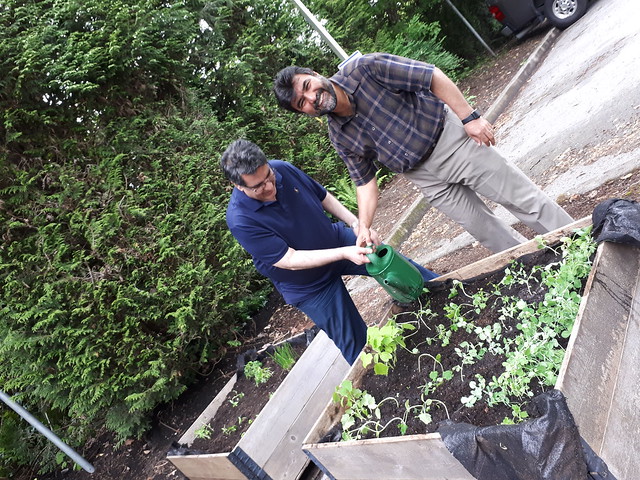
Now in it’s 8th year, Prism’s humble garden is a gathering place for outdoor meetings and breaks, while providing healthy snacks and habitat for the bees. Over the years, it has taken various shapes and been stewarded by various staff members. This year, the Prism Green Team renovated the garden beds and planted new perennials and chose to plant veggies that would be easy for anyone to harvest. The team also thought about how to make the whole process zero waste by using recycled containers to plant seedlings and by repairing the existing beds instead of replacing them.
Towards Zero Waste
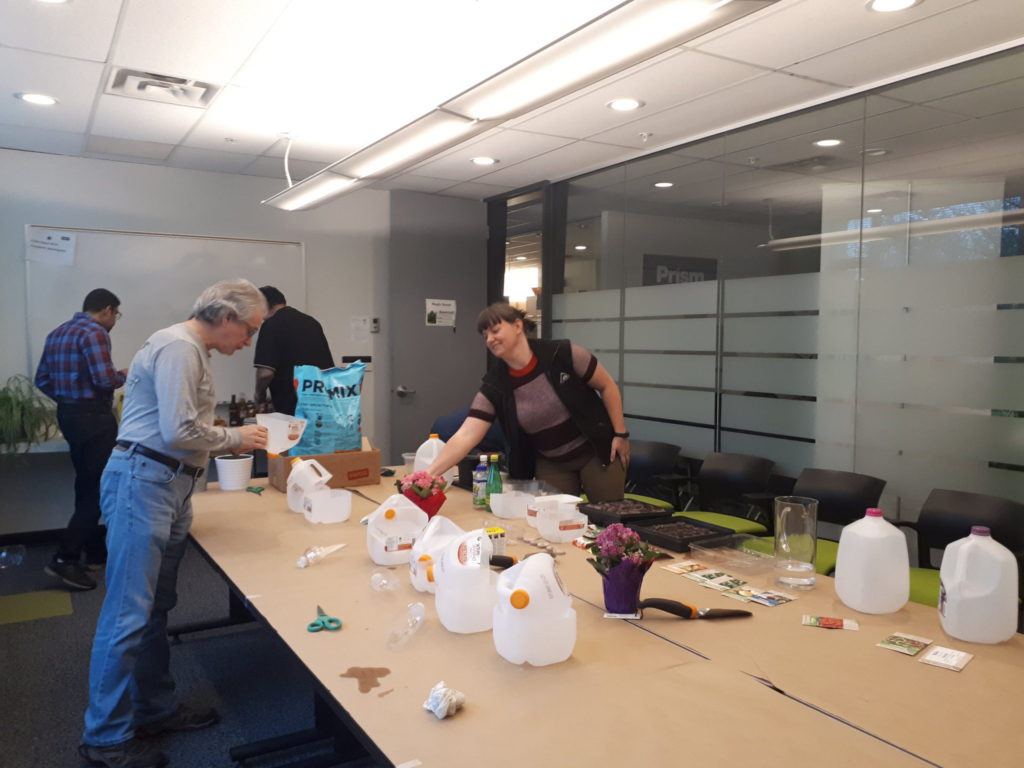
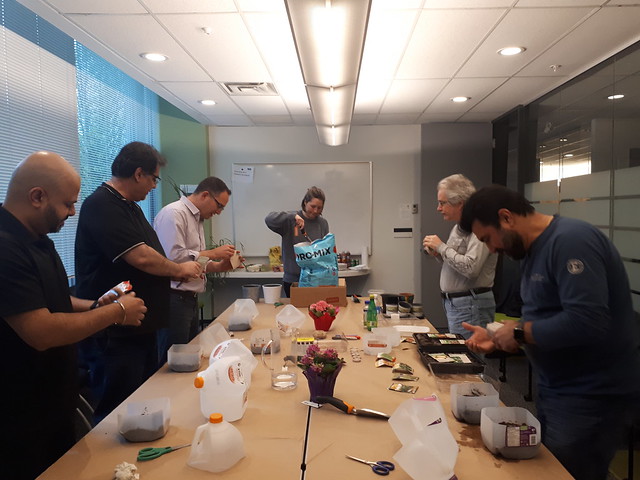
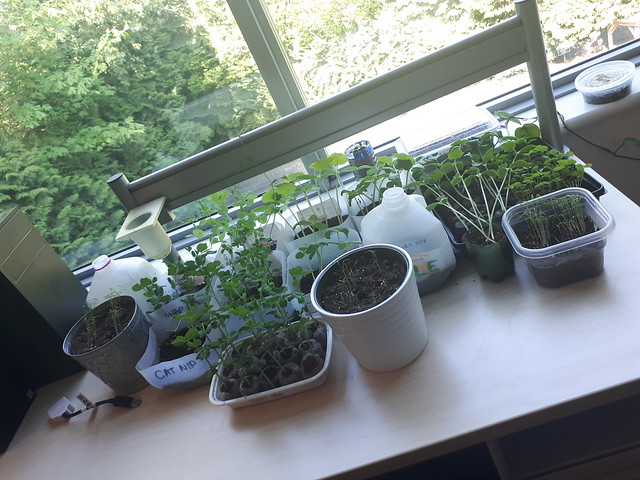
Prism’s Green Team repurposed old milk jugs and food containers to hold seedlings and make a mini greenhouse that sat by the window in the office. Every few days, Green Team members would tend to the seedlings and we all got to watch them sprout.
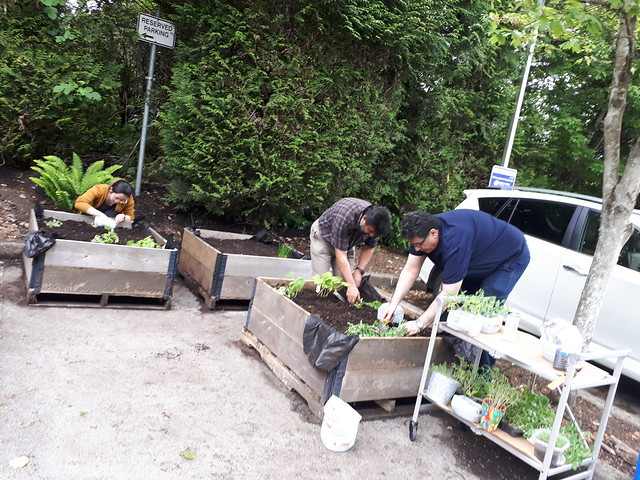
Planting seedlings in the renovated garden beds
Now several years old, the garden beds have withstood the seasonal changes, and a few brushes with cars backing up. Rather than replace them, the team acquired the necessary hardware to bring them back to life.
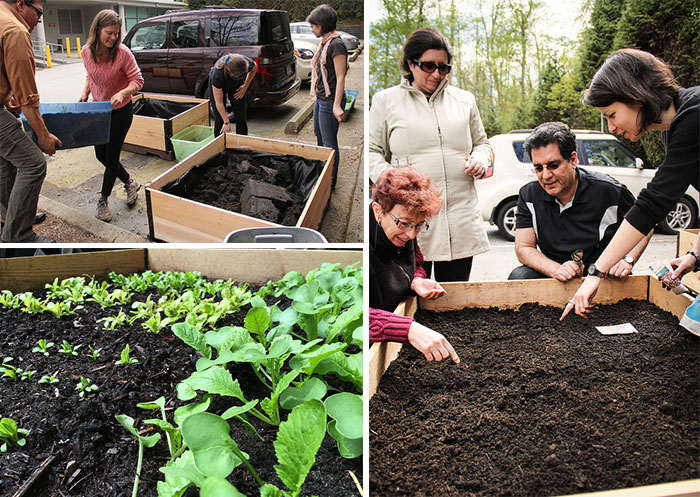
Flashback to the summer of 2014 when we went from plastic bins to the cedar garden beds that we still have five years later. That summer many staff lunches at company meetings were supplemented with fresh salads from our garden.
Bringing 25 years of experience to Prism
From opportunity identification and concept design to implementation and final review, mechanical projects at Prism often leverage the talents of a team of people through collaboration. Recently, we were fortunate to have Hamid Samani, P.Eng., LEED AP, join our mechanical team. “Hamid has a breadth of experience in the technologies and industries where we do the most work,” says Mechanical Team Lead Stephen Kooiman, “he is a key technical resource in supporting our team with detailed engineering designs.”
Hamid’s 25 years in the industry have encompassed a broad range of projects; he brings a wealth of accumulated experience and expertise to all projects and is adept at negotiating the complexities and operational parameters of working within commercial, educational, institutional, and residential developments. His experience includes sustainable design, energy compliance analyzing and energy modeling, project management, HVAC system design, plumbing and fire protection systems design, specification writing, and construction reviews. As a LEED Accredited Professional, he is dedicated to implementing sustainability in his work.
His interest in designing systems started at a young age, growing up in Iran, “My father was an electrical technician and I used to go work with him,” says Hamid, “then later at high school, I was pretty good at math and physics and that moved me down a path towards engineering.”
“Really it was just an interest in making and creating things—in the end, that’s what it’s all about,” he says.
Outside of work, Hamid enjoys gatherings with friends and family—his wife Maryam, daughter Sara (23 years old) and son Parsa (16 years old). He has also enjoys carpentry and home projects, having just finished putting in an irrigation system in his backyard.
It’s clear his curiosity is still fueling his work and he emphasizes that as an engineer you have to be continually developing your knowledge, “From new technologies to new codes and standards, we need to understand how to use them in our designs.”
Hamid says what drew him to Prism was the focus on energy saving, “Being in this industry you get to know how much building systems, especially mechanical systems, consume in electricity and fossil fuels. If we can design a system that uses less energy, there’s no reason we shouldn’t be doing so.” He adds, “”I’d like to keep this earth for the future!”
Since joining Prism, Hamid has already started working on implementing a heat recovery chiller upgrade project at a Vancouver hospital, and a chiller plant capital renewal and energy project for a BC mine with an anticipated energy savings of 60% for the chiller plant.
We’re grateful to have Hamid Samani on our team and we look forward to introducing more new staff in the coming months. We’re always on the lookout for talented people who share our core values. Find our latest postings here.
International Women in Engineering Day in June
Women currently account for only 13.1 per cent of engineers in Canada. With International Women in Engineering Day coming up on June 23rd, 2019, we’re taking the opportunity to reflect on how far we’ve come and how far we have yet to go as an industry.
Prism Electrical Designer Alison Bodine shares a few thoughts on being a woman in the engineering field in this short video clip.
How are we supporting women in engineering at Prism? There is more to be done and we are determined to be better.
Prism President Robert Greenwald shared these reflections:
Probably the most important part of our culture is how we treat all people with respect, regardless of our differences, including gender. We don’t differentiate between the work of a female or male engineer nor do we treat our co-op students, young Engineers in Training, or Professional Engineers differently based on gender. This applies to wages, responsibilities and opportunities. We do work with our staff with young families on how we can adapt their work life with a young family, and that typically does apply more to our female staff. We are also nurturing a “culture of care” where employees can feel comfortable bringing up issues or concerns.
We provide time at work for staff to volunteer at events that encourage girls and women to consider careers in STEM. It’s important that we do this throughout the year and not just during days or month to encourage Women in Engineering. Last year, we participated in “diversity circles” relating to the 30 by 30 initiative, a target by Engineers Canada to increase the ratio of newly licensed engineers who are women to 30% by 2030 (BC is at 15.2% now, Canada at 17.9%). According to Engineers Canada, “”thirty percent is universally held as the tipping point for sustainable change””. This diversity circle was focused on how educational institutions can support the initiative.
More recently, Prism signed up as one of 49 sponsors and members for 49Women in Science Circle, an initiative by Langara College designed to encourage and celebrate women in STEM. This will provide an opportunity for one of our women engineers to be part of a community of 48 other technical women. I expect that our whole company can benefit from these experiences.
In addition to women in STEM, we need to encourage women in leadership positions in our industry. At Prism, our leadership team is richer due to the participation of women. Various project lead and key client relationship positions are led by women and we are encouraging more women to get involved in leading service areas as we grow.
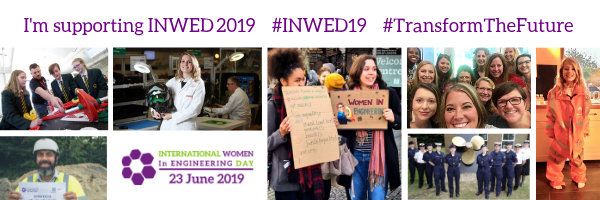
International Women in Engineering Day is an annual festival developed and coordinated by the Women’s Engineering Society (WES) to celebrate the achievements of women in engineering and inspire younger generations. Established in 2014 as a UK-wide event, INWED went global in 2017 with international support.
Find resources for organizing an event via www.inwed.org.uk/resources.html
What it means to work at Prism Engineering
If you walk into the Prism office on any given day, you’ll see the energy efficient technologies we’ve installed, and you’ll also get to see the people behind the projects. Over the years, we’ve been fortunate to work with dedicated people who we’re proud to have both as clients and staff. With our then Senior Mechanical Engineer, Duane Mattson, approaching his retirement after 17 years with Prism, we started thinking about sharing some of the things that make Prism’s culture unique.
Early this year, Prism staff, Duane, Faisal, Christine, Alison and Joany, generously sat down to reflect on what it’s like to work at Prism and what motivates us as a company to make a difference.
So what defines that culture?
“It’s hard to describe,”” says Prism President Robert Greenwald, “but I think there are five things that stand out.” Here’s what he shared:
- When we ask people what they like most about Prism, the top answer is always the people. Being part of Prism provides us with connections and a work community. We will continue to nurture this sense of family, both within teams and between teams.
- Also high up there is the feeling people have about making an impact by doing meaningful work. We can see the results of what we do not only in terms of saving energy but also in terms of modernizing buildings and supporting organizational change. We will continue to find interesting and challenging work to give our staff the opportunity to grow with us.
- It may be easier to show that you care as a smaller company but we will continue to listen, to be attentive and thoughtful about the needs of our staff. Through open communication and accessible leadership we will strive to improve and address any concerns that arise.
- Our culture also includes a drive for performance. We often have deadlines and workload pressures. We will continue to balance the need for deliverables and your work life balance. We are not in it for a sprint, but rather for the long term.
- We have developed an entrepreneurial spirit to get here. We have developed new products like PUMA, programs around voltage optimization, services in Sustainability, and now Strategic Energy Management. We will continue to pursue these opportunities and give our staff opportunities for growth and innovation through collaboration and teamwork.
“Our culture is created by every person that works at Prism,” says Greenwald, “we are excited by our team.”
We’re always on the lookout for talented people who share our core values. Find our latest postings here.
A few photos from behind the scenes in December:

Join PUMA’s Spring Workshops
There are a several events coming up in the next few months that we are hosting and participating in.
- May Workshop: Burnaby, BC on May 16th, 2019
- EFMA-BC Tradeshow: Penticton, BC May 28th to 30th
- BOMA QBT: Lunch presentation June 5th, 2019
Please contact duncan@prismengineering.com for more information or details of how to join us.
Growing healthy and well
At Prism, we understand that supporting health and wellness is an integral part of managing a company and enabling staff to thrive. Research shows that investing in health and wellness programs leads to better employee retention, productivity and even sense of purpose. While Prism offers comprehensive extended health benefits to employees, “We knew more could be done, and at the same time wanted to provide opportunities for our staff to be part of leading new initiatives in the office,” says Sarah Smith, Prism’s Sustainability Team Leader and Director of Employee Experience.
Sparking new ideas
In 2017, several Prism staff led a ‘spark group’ to help jumpstart and pilot a few ideas towards health and wellness. With folks from different teams in the company, the group started things off by coming up with a collective understanding of what health and wellness meant. Out came the flipcharts, and in the discussion, the group gravitated towards two areas, physical health and mental health, while acknowledging this was just one way of linking things together.
